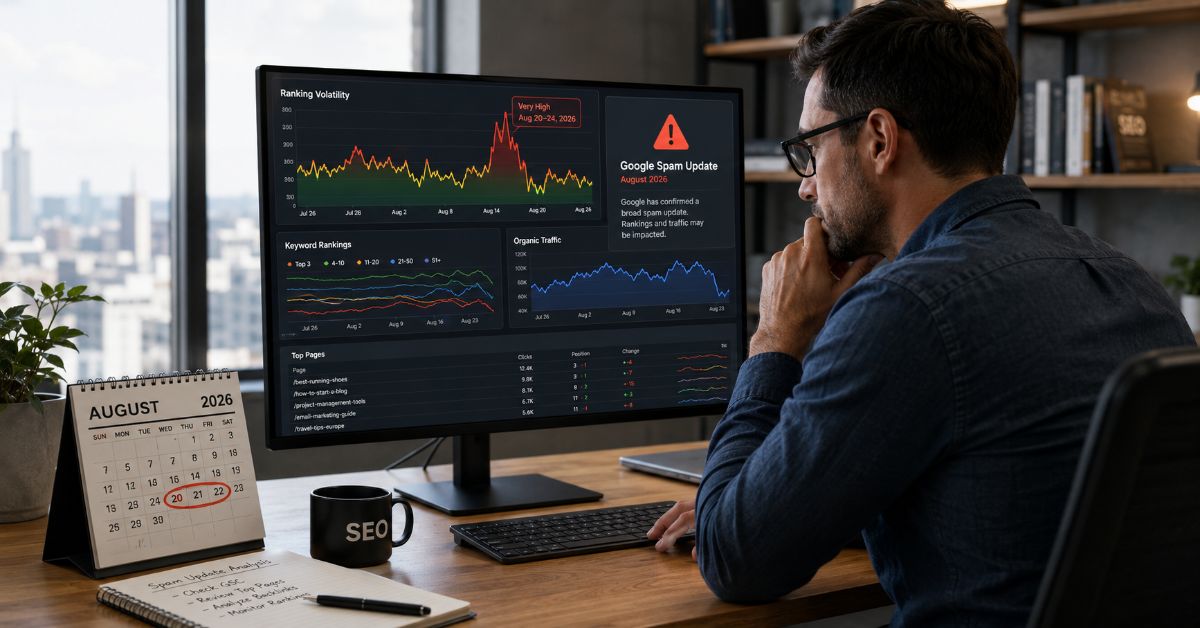
AlgoUpdateTimes August 2026 records one confirmed Google ranking update and several separate periods of substantial search volatility. I tracked the month around Google’s August 2026 spam update, which began on August 18 and finished on August 21, applied globally and to all languages, and was followed by continued ranking movement after the official rollout ended. The most important distinction is timing: volatility seen on August 1 to 3, August 5 to 6, and August 12 to 13 was not part of the announced spam update simply because it happened earlier. Google’s John Mueller explicitly said Google does not begin a named rollout days before announcing it. That makes August a useful reminder that an SEO chart can contain several overlapping stories at once: unconfirmed ranking changes, a confirmed spam update, reporting anomalies, normal competitive movement, and shifts in search demand.
Why does that matter now? Because the August spam update appears to have produced unusually severe ranking displacement in at least one large third-party dataset. SE Ranking analyzed the same 100,000 U.S. keywords across 20 industries before and after the rollout and found that 16.71% of URLs that had been in the top 10 fell beyond position 100, versus 9.2% in its July baseline comparison. At the same time, Google Search Console documented logging problems affecting Discover and generative AI performance data around August 13 to 17, so not every ugly chart represented a real visibility loss. In this update log, I separate confirmed events from unconfirmed volatility, show what the available data can and cannot prove, and lay out the checks I would run before changing content, links, templates, or site architecture. The goal is not to label every traffic drop an algorithm penalty. It is to narrow the diagnosis until the evidence points to a specific cause.
What this means for site owners, SEOs, and publishers
The practical takeaway is to diagnose August changes by date and by data source before making recovery decisions. A drop that began on August 2 should not be blamed on the August 18 spam update. A Search Console Generative AI impression drop limited to August 13 through August 17 may be a logging artifact rather than lost visibility. A sustained fall that begins during the August 18 to 21 rollout, appears in independent rank tracking, affects important query groups, and is mirrored by competitors moving upward is more consistent with a real ranking event.
For a first-pass check, use the Update Impact Checker to line up the date your traffic changed with confirmed Google rollouts. Then compare page-level clicks, impressions, average position, and query mix in Search Console. If the movement looks persistent, the Ranking Recovery guides are the better next step than making a sitewide rewrite based on a single daily graph.
Publishers should be especially careful with revenue-driven reactions. Search volatility can change traffic distribution before it changes total clicks, and SERP features can alter click-through rates without a matching ranking loss. In-house SEO teams should annotate dashboards with the confirmed rollout window and with known Search Console anomalies so product, editorial, and executive teams do not treat instrumentation noise as algorithmic fact. Agencies should preserve pre-change snapshots of rankings, templates, internal links, indexation, and conversion metrics before implementing a recovery plan. Without that baseline, it becomes difficult to tell whether a subsequent improvement came from the fix, from the end of a rollout, or from unrelated market movement.
AlgoUpdateTimes August 2026: what actually changed?
August 2026 contained one confirmed Google spam update, at least three clearly documented periods of unconfirmed ranking volatility before it, and another period of volatility after it. Google’s own Search Status Dashboard is the source of truth for the named rollout. Industry volatility reports are useful context, but they are not official confirmations of a Google update.
The timeline below separates those categories so the month does not get flattened into one continuous algorithm event.
| Date / window | Status | Verified signal | Interpretation |
| Aug 1 to 3 | Unconfirmed volatility | Multiple third-party trackers and SEO chatter spiked | Separate from the later named spam update |
| Aug 5 to 6 | Unconfirmed volatility | Tracking tools and community reports showed larger swings | No Google confirmation of a named update |
| Aug 12 to 13 | Unconfirmed volatility | Multiple trackers showed another spike | Overlaps with later-documented Search Console logging issues |
| Aug 18, 09:27 PDT | Confirmed update begins | Google Search Status Dashboard opened August 2026 spam update incident | Global, all languages |
| Aug 21, 01:49 PDT | Confirmed update completes | Google marked rollout complete | Official rollout lasted 2 days, 16 hours |
| Aug 26 | Post-update volatility | Third-party tools and community chatter remained elevated | Do not relabel as confirmed without Google confirmation |
| Aug 28 | Policy change announced | Google clarified site reputation policy treatment in the EEA | Separate policy development; effective Aug 30 |
This distinction is also why the site’s Algorithm Updates archive should be read as a record of confirmed and analyzed events, not as proof that every spike in a volatility tool corresponds to a named Google release.
What was the August 2026 spam update?
The August 2026 spam update was a global improvement to Google’s automated spam-detection systems, not a core update. Google’s incident page says the rollout started at 09:27 Pacific time on August 18 and ended at 01:49 Pacific time on August 21, a duration of 2 days and 16 hours. Google also stated that the update applied globally and to all languages.
What did Google confirm about the rollout?
Google confirmed the name, start time, completion time, global scope, and language scope. Its broader spam-update documentation says Google’s automated systems for detecting search spam operate continuously, while notable improvements to those systems are sometimes announced as spam updates. Google identifies SpamBrain as one of its AI-based spam-prevention systems and advises sites that lose visibility after a spam update to review the spam policies rather than chase a single ranking factor.
The update was also the third announced spam update of 2026. Google’s status history lists a March 2026 spam update and a June 2026 spam update before the August release. The short August rollout contrasts with the much longer August 2025 spam update, which Google’s history shows lasted more than 26 days. Rollout length by itself does not tell us the severity of an update, but it does define the period in which cause-and-effect analysis is most defensible.
What did Google not confirm?
Google did not publish a percentage of queries affected, a list of industries targeted, a catalog of winning or losing domains, or a statement that the update was aimed at generative AI content. Google’s spam policies now explicitly cover attempts to manipulate generative AI responses in Google Search, but that policy scope does not prove the August update specifically targeted AI-generated pages or AI-search manipulation. Semrush made the same distinction in its August overview: the policies apply to generative AI experiences, but Google did not say this update was specifically about that behavior.
That gap matters. If a site lost rankings during the rollout, the evidence supports reviewing spam-policy compliance. It does not support declaring that one content format, one CMS, one affiliate model, or one AI workflow was the target unless independent domain-level analysis demonstrates that pattern. Even the strongest public impact dataset released after the update measured ranking movement, not the reason each URL moved.
How disruptive was the August 2026 spam update?
The best quantified public evidence available by August 29 suggests the rollout was more disruptive than normal ranking churn, although the dataset cannot identify why individual pages lost positions. Search Engine Land reported SE Ranking’s analysis of 100,000 U.S. keywords across 20 industries, comparing August 17 with August 22 and using July 26 versus July 31 as a no-confirmed-update baseline.
The headline numbers are substantial enough to treat the update as a serious diagnostic window, but they should be interpreted as sample-based measurements rather than a census of Google Search.
| SE Ranking measure | August update comparison | July baseline / context | What it shows |
| Prior top-10 URLs falling beyond top 100 | 16.71% | 9.2% | Severe displacement was materially higher during the update window |
| Increase in top-10 to beyond-top-100 losses | 82% higher than baseline | Baseline set from Jul 26 to Jul 31 | Update-period churn exceeded normal comparison period |
| Top-10 volatility across 20 niches | 74.64% to 85.55% | Real estate lowest; fashion and beauty highest | Movement was broad across tracked industries |
| New post-update top-three URLs from outside prior top 20 | 12% increase | Compared with pre-update state | The update also created substantial upward churn |
| Dataset size | 100,000 U.S. keywords | 20 industries | Large sample, but not all of Google Search |
The most striking result is the movement from the top 10 to beyond position 100. During the update comparison, 16.71% of URLs that had ranked in the top 10 were no longer found within the top 100 for the same keyword. In the July baseline, that figure was 9.2%. Search Engine Land described the difference as an 82% increase in this kind of severe displacement. A URL that drops from page one to outside the tracked top 100 is experiencing something qualitatively different from a routine move of one or two positions.
The same analysis found broad volatility across all 20 tracked niches. Top-10 volatility ranged from 74.64% in real estate to 85.55% in fashion and beauty. Real estate and healthcare, both categories where inaccurate information can have serious consequences, were among the steadier categories in that particular dataset. That does not mean Google gave YMYL sites special protection. It only describes the relative movement observed in the sample.
There was also churn in the other direction. SE Ranking saw a 12% increase in the share of URLs ranking in the top three after the update that had not been in the top 20 before it. That reinforces an important point about updates: every loss is paired with a replacement. Recovery work therefore needs competitor analysis, not only self-analysis. If several competing pages gained while yours fell, compare their intent fit, originality, trust signals, site integration, and technical accessibility before assuming the problem is a single missing keyword or a link metric.
What did the unconfirmed August ranking volatility mean?
The pre-rollout volatility should be treated as separate, unconfirmed ranking activity. Search Engine Roundtable documented noticeable movement on August 1 to 3, a stronger wave around August 5 to 6, and another spike around August 12 to 13. Third-party tools and SEO-community reports lined up around those periods, but Google did not label them as part of the August spam update.
August 1 to 3 and August 5 to 6
On August 3, Search Engine Roundtable reported that several third-party tracking tools were showing a spike and that SEO-community chatter had increased after movement beginning on August 1. By August 6, the publication described a larger increase in chatter and tool volatility, with some site owners reporting sharp swings and reversals. These observations are useful because multiple independent trackers can reveal that a SERP is unusually unstable. They still do not tell us which Google system changed or whether Google intentionally shipped one discrete update.
For diagnosis, the value of these dates is exclusion. If your decline began materially before August 18 and remained stable through the official spam rollout, the spam update is a weak explanation for the initial loss. You may still have been affected later, but the first movement needs its own investigation. That investigation should include competitor changes, technical deployments, content changes, indexation, seasonality, SERP-feature shifts, and query-level demand.
August 12 to 13
A separate volatility spike was documented around August 12 to 13. Search Engine Roundtable reported that tracking tools showed movement outside normal day-to-day levels and listed data sources including Advanced Web Ranking, MozCast, Semrush, SISTRIX, AccuRanker, Similarweb, and others. This event is especially easy to misread because Google Search Console also had reporting anomalies around the same dates.
That overlap makes August 13 a textbook case for triangulation. A rank tracker can show that positions moved. Search Console can show whether clicks and impressions changed. Analytics can show sessions and conversions. Server logs can show crawling and landing-page requests. When one system reports a drop but the others do not, investigate measurement before changing the site. When several independent systems move together, the probability of a real visibility change rises.
Volatility after August 21
The official spam rollout ended on August 21, yet ranking volatility did not immediately settle. Search Engine Roundtable documented continued movement on August 26, along with fresh community chatter and signals from multiple third-party tools. That post-rollout activity should not automatically be called an extension of the spam update because Google had already marked the rollout complete.
Post-update volatility can have several explanations. Search systems continue to change outside named updates, pages are recrawled and reevaluated at different times, competitors react to their own losses and gains, and query demand changes. The useful editorial rule is simple: label a confirmed update only where Google confirms it, and label everything else as volatility or an unconfirmed ranking change. That language keeps the record accurate even when the SERPs are visibly moving.
How should you separate algorithm impact from Search Console reporting noise?
You should separate ranking evidence from measurement evidence before diagnosing an August traffic loss. Google’s Search Console data-anomalies page records a logging error that reduced Discover clicks and impressions for August 13 and reduced reported impressions for generative AI features in Discover. It also records a logging error that reduced impressions in the Generative AI performance report in Search from August 13 through August 17. Google says these issues affected data logging only.
That means a chart can look worse without the underlying search visibility being equally worse. If a property had access to the affected generative AI reports, a drop isolated to those report dimensions during the documented dates should be annotated, not treated as immediate evidence of an algorithmic demotion. This is particularly important because the reporting anomaly occurred only days before the confirmed spam rollout, creating an easy but misleading narrative in which every August decline appears connected.
I would compare at least four views before taking action: total web-search clicks and impressions, page-level average position for affected URLs, an independent rank-tracking sample for priority queries, and analytics or server-side landing-page traffic. If Search Console impressions fall while rank tracking, sessions, and conversions remain stable, a reporting explanation deserves more weight. If rankings, clicks, sessions, and conversions all fall together during the confirmed rollout, the case for a real search-performance change is stronger.
For teams that report weekly, annotate August 13 to 17 directly in dashboards. For agencies, include the anomaly in client notes so later month-over-month comparisons do not treat missing or reduced logging as a baseline. For publishers, avoid rewriting high-performing pages based solely on a temporary reporting dip. Changes made during ambiguous measurement periods can create a second problem that obscures the first.
Which spam policies matter most after the August update?
The correct audit scope is Google’s current spam-policy framework, not a list of rumored August targets. Google defines search spam as techniques intended to deceive users or manipulate Search systems, including attempts to manipulate generative AI responses in Google Search. The policies cover cloaking, doorway abuse, expired-domain abuse, hacked content, hidden text and link abuse, keyword stuffing, link spam, scaled content abuse, scraping, site reputation abuse, and other manipulative practices.
Scaled content abuse and scraping
Scaled content abuse is not a synonym for using AI. Google describes it as producing many pages primarily to manipulate rankings rather than help users, regardless of how the pages are created. Its examples include using generative AI to create large amounts of low-value content, scraping or transforming feeds and search results without adding value, stitching content from different sources without meaningful benefit, and producing pages that make little sense to readers but contain search terms.
The practical audit is therefore outcome-based. Look for sections of the site where pages exist mainly because a keyword list exists. Check whether pages have original reporting, first-hand evidence, unique data, expert interpretation, or a real utility that a competing page cannot provide. If hundreds of pages differ only by a location, product modifier, or lightly rephrased introduction, the risk is structural. Editing a few sentences will not fix the underlying reason the pages were created.
Site reputation abuse and the August 28 policy clarification
Site reputation abuse also deserves attention, but it should not be casually conflated with the August spam rollout. On August 28, Google published a separate update to its site reputation policy following discussions with the European Commission. Google said that beginning August 30, manual actions under this policy would have a different effect for users in the European Economic Area than for users outside it. Within the EEA, affected sections may be categorized separately from the main domain rather than receiving the same manual-action effect used outside the EEA.
That policy change is important for large publishers and marketplaces that host third-party sections, but it is a separate policy and enforcement development. If an affected site saw movement during the August 18 to 21 spam update, it should not assume the site reputation policy change explains the movement. Use the dates. Check Search Console’s Manual Actions report. Separate automated ranking changes from manual enforcement and from the EEA-specific approach Google announced for August 30.
Generative AI manipulation
Google’s May 2026 documentation update clarified that spam policies apply to attempts to manipulate generative AI responses in Search. This matters for AI Overviews and AI Mode because tactics designed to game a generated answer are not outside the spam framework. However, the policy is broader than the August update. There is no verified statement that the August 2026 spam update was an ‘AI content update’ or an ‘AI Overview manipulation update.’
For teams that need a plain-language foundation before a policy audit, the SEO Basics archive can be used alongside Google’s primary documentation. The safest interpretation is still the narrow one: comply with the full spam policies and avoid inventing a target Google did not name.
What should site owners audit after the August 2026 spam update?
Start with policy exposure and evidence, then move to page quality and technical validation. Do not begin by deleting links, removing hundreds of pages, changing every title, or rewriting the entire site. Large reactive changes can destroy useful evidence about what actually moved and can make recovery harder to measure.
1. Lock the timeline before changing anything
Record the first date and hour of the visible decline, the affected search type, the most affected directories, and whether the change started before, during, or after August 18 to 21. Export Search Console data for at least several weeks before the event and preserve rank-tracking snapshots. Note deployments, migrations, template changes, robots directives, canonical changes, CDN incidents, and content launches. A timeline is not paperwork. It is the filter that prevents a plausible story from becoming a false diagnosis.
2. Check for manual actions and security issues
Spam updates are primarily about automated systems, but Search Console’s Manual Actions and Security Issues reports should still be checked. A manual action is a separate enforcement mechanism and should be handled according to the specific notice. Security problems can inject pages, redirects, hidden links, or spam that mimic an algorithmic loss. If Google reports a manual action or hacked-content issue, that evidence takes priority over speculative update analysis.
3. Map losses by template and intent
Segment losing URLs by page type, directory, template, authoring workflow, intent, and traffic source. If only one programmatic directory collapsed while editorial guides remained stable, investigate the programmatic system. If affiliate comparison pages fell while informational articles held, inspect commercial intent, originality, disclosure, and added value. If the whole domain fell evenly, widen the audit to sitewide quality, technical accessibility, link profile, and brand or demand changes.
4. Compare winners, not just losers
For each important query group, capture the URLs that replaced your pages. Compare what those pages provide that yours does not: first-hand evidence, clearer intent satisfaction, unique data, stronger product information, better source attribution, more current details, or a more coherent site context. Avoid cosmetic comparisons such as word count. A longer page can still be less useful. The SE Ranking data shows meaningful replacement churn, so competitor analysis is essential to understanding the new result set.
5. Review scaled sections and third-party publishing
Inventory pages created through templates, feeds, automation, third-party contributor programs, syndication, and bulk AI workflows. Ask whether each section would still deserve to exist if search traffic disappeared. That question is useful because it exposes pages whose primary purpose is ranking capture. For third-party sections, document who owns editorial standards, who reviews content, how authorship is disclosed, and whether the section is integrated into the site’s normal navigation and quality controls.
6. Improve in coherent batches and keep a change log
When the evidence points to a weakness, fix the system that created it. If a template produces thin location pages, redesign the template and data inputs. If editorial pages lack original evidence, build a research and expert-review process. If old pages are redundant, consolidate deliberately with redirects where appropriate. Change logs should record the date, URL set, reason, and expected outcome. This makes later recovery analysis possible and helps teams avoid repeating unsuccessful interventions.
What should in-house SEOs and agencies report to stakeholders?
Report certainty levels, not just conclusions. A useful August update report should separate confirmed Google events, observed ranking movement, measurement anomalies, and hypotheses. This keeps executives from hearing ‘Google update’ when the evidence only supports ‘traffic moved during a volatile week.’
For a confirmed event, report the official rollout window, affected search product, and what Google actually said. For observed volatility, name the trackers or ranking datasets that moved and state that Google did not confirm a named update. For Search Console anomalies, cite the affected report and dates. For site-specific impact, show the business metrics that changed: non-brand clicks, qualified sessions, conversions, revenue, leads, or subscriptions. Rankings matter, but they are not the final business outcome.
Agencies should resist universal recovery playbooks. Two clients can lose traffic during the same rollout for different reasons, and one can lose traffic for reasons unrelated to the rollout. Build a client-specific evidence pack: affected folders, top losing queries, replaced competitors, pre-existing quality risks, technical changes, link anomalies, and Search Console notices. Then rank hypotheses by evidence strength. The strongest action plan is the one that can explain why a specific group of pages lost and why the replacement pages gained.
In-house teams should connect update analysis to product and editorial ownership. If the issue sits in a templated content system, the SEO fix may require engineering and data changes. If the issue is weak first-party evidence, it may require editorial budgets, subject-matter experts, or product access. If the issue is site reputation risk, it may require governance over partnerships and third-party publishing. Calling every problem ‘SEO’ can hide the operational owner who actually has to fix it.
What does Google say about recovery after a spam update?
Google’s official guidance is to review the spam policies and bring the site into compliance, then allow its automated systems time to reassess the site. Google warns that improvement can take months because systems need to learn that a site is complying over time. That is very different from a promise that rankings will rebound when a named rollout ends.
This is one reason short-term reversal chasing is risky. If a site believes it was affected by a spam update, changing a handful of titles or publishing a burst of new articles is unlikely to address a systemic policy problem. Recovery should correspond to the suspected cause. A scaled-content problem needs fewer, better, more purposeful pages and a better production standard. A hacked-content problem needs security remediation. A cloaking or redirect problem needs technical cleanup. A third-party publishing problem needs governance and integration, not superficial copy edits.
Google’s spam-update documentation also makes a special point about link spam updates: when spammy links lose their ranking benefit, that lost benefit cannot simply be restored by removing or disavowing the links. The August 2026 update was announced as a spam update, not specifically as a link spam update. That distinction matters because a panic-driven backlink purge is not supported by the announcement. Review links when you have evidence of a link problem, not because a generic spam update happened.
Recovery measurement should use stable cohorts. Track the same set of affected URLs and queries over time, separate branded from non-branded demand, and compare against unaffected sections of the site. Watch whether crawling and indexation normalize, whether replaced pages regain positions, and whether conversions recover along with rankings. A true recovery is not a one-day bounce. It is a sustained improvement that survives normal volatility.
How can you tell whether August losses were algorithmic, competitive, technical, or measurement-related?
Use a multi-signal diagnosis rather than one chart. The table below summarizes the evidence patterns I would use when reviewing an August 2026 decline.
| Pattern | Evidence to look for | More likely explanation | First action |
| Drop starts Aug 18 to 21 across many query groups | Rank tracker, Search Console, analytics move together | Confirmed spam-update impact is plausible | Audit spam-policy exposure and affected page cohorts |
| Drop starts well before Aug 18 | Rankings changed on Aug 1 to 13 | Earlier unconfirmed volatility, competition, or site change | Investigate the earlier date independently |
| Generative AI or Discover chart dips Aug 13 to 17 | Other traffic sources and rankings remain stable | Known Search Console logging anomaly | Annotate data and avoid reactive edits |
| One directory or template collapses | Other site sections remain stable | Template, quality, or technical issue concentrated in that section | Audit that system and compare replacement pages |
| Manual Action or Security notice appears | Search Console provides explicit notice | Manual enforcement or security problem | Follow the notice and remediate the named issue |
| Positions stable but clicks decline | SERP layout, CTR, demand, or feature mix changes | Not necessarily a ranking demotion | Review query demand and SERP composition |
No single row is decisive on its own. For example, a technical deployment can coincide with an algorithm update, and a site can experience both a Search Console logging anomaly and a real ranking loss. The job is to find the explanation that accounts for the largest share of the observed change with the fewest unsupported assumptions.
A useful test is reversibility. If a traffic drop disappears when a reporting bug ends but rankings and analytics never moved, measurement was the likely cause. If a specific template loses rankings immediately after a robots or canonical change and returns after the change is fixed, technical causation becomes strong. If a broad set of policy-risk pages loses during a confirmed spam rollout and replacement pages are materially more useful or trustworthy, an algorithmic explanation becomes more plausible.
What should publishers watch next after August 2026?
The next watch points are continued post-update volatility, the August 30 EEA change to site reputation policy enforcement, and any new confirmed ranking incident Google adds to the Search Status Dashboard. As of August 29, Google’s current dashboard shows no active ranking incident, so there is no basis for labeling the post-August-21 movement as a second confirmed update.
Publishers should also watch whether the severe displacement seen in the SE Ranking sample persists after the SERPs settle. Early post-update datasets are valuable, but they can overstate or understate long-term impact if rankings continue to rotate. Re-run important query cohorts after several weeks and compare the composition of winners and losers. Look for durable patterns by page type, content model, and site section rather than assuming every early loser remains a loser.
The policy environment is also becoming more explicit about generative search. Google’s spam-policy language now reaches manipulation of generative AI responses, and Search Console has dedicated generative AI performance reporting for some properties. That means SEO teams need better measurement discipline across classic blue-link rankings, AI surfaces, Discover, and business outcomes. A visibility change in one surface should not automatically be generalized to all of Search.
For AlgoUpdateTimes, the editorial standard going forward should be the same one used here: confirmed updates get exact start and end times from Google; unconfirmed volatility is labeled as unconfirmed; reporting anomalies are kept separate from ranking changes; and third-party datasets are described with their sample and limitations. That makes the monthly log useful as a diagnostic reference, not just a chronology of headlines.
Frequently Asked Questions
Was the August 2026 Google spam update global?
Yes. Google’s Search Status Dashboard said the August 2026 spam update applied globally and to all languages. The rollout began August 18 and was marked complete on August 21.
Did Google say the August 2026 spam update targeted AI-generated content?
No. Google’s spam policies apply to manipulative behavior regardless of how content is produced, and they now cover attempts to manipulate generative AI responses in Search. Google did not state that the August update specifically targeted AI-generated content.
Was the volatility before August 18 part of the spam update?
Google’s John Mueller said named updates are not rolled out days before their announcements. The volatility documented on August 1 to 3, August 5 to 6, and August 12 to 13 should therefore be treated as separate unconfirmed movement, not the announced August spam rollout.
How long can recovery from a spam update take?
Google says sites should correct spam-policy violations and understand that automated systems may take months to learn that a site is complying. There is no guaranteed recovery date tied to the end of the rollout.
Should I disavow links because of the August 2026 spam update?
Not solely because the update happened. The August release was a general spam update, and Google did not announce it as a link spam update. Review or disavow links only when you have specific evidence of a link-related problem and understand the consequences.
Sources
Google Search Status Dashboard incident – official start time, end time, global scope, language scope, and rollout completion.
Google Search spam updates documentation – official explanation of spam updates, SpamBrain, compliance review, and recovery timing.
Google spam policies – current definitions of spam, scaled content abuse, scraping, and manipulation of generative AI responses.
Search Engine Land rollout completion – independent confirmation of completion timing and 2026 update context.
Search Engine Land SE Ranking impact analysis – 100,000-keyword dataset, 20-industry coverage, top-10 losses, volatility range, and top-three churn.
Search Engine Roundtable August 1 to 3 volatility – documentation of early-August unconfirmed ranking volatility and tracker activity.
Search Engine Roundtable August 5 to 6 volatility – documentation of the second early-August volatility wave and community chatter.
Search Engine Roundtable August 12 to 13 volatility – documentation of the mid-August volatility spike and tracker sources.
Search Engine Roundtable post-update volatility – documentation of continued volatility after the official August 21 completion.
Search Engine Roundtable John Mueller timing report – John Mueller statement that named updates are not rolled out beforehand.
Semrush August 2026 spam update overview – third-spam-update context and distinction between policy scope and unconfirmed targeting.
SISTRIX Google Updates tracker – secondary confirmation of the August 18 to 21 update window.
Google Search Console data anomalies – official logging anomalies affecting Discover and generative AI performance reports in August.
Google Search Central site reputation policy update – August 28 policy clarification and August 30 EEA enforcement change.