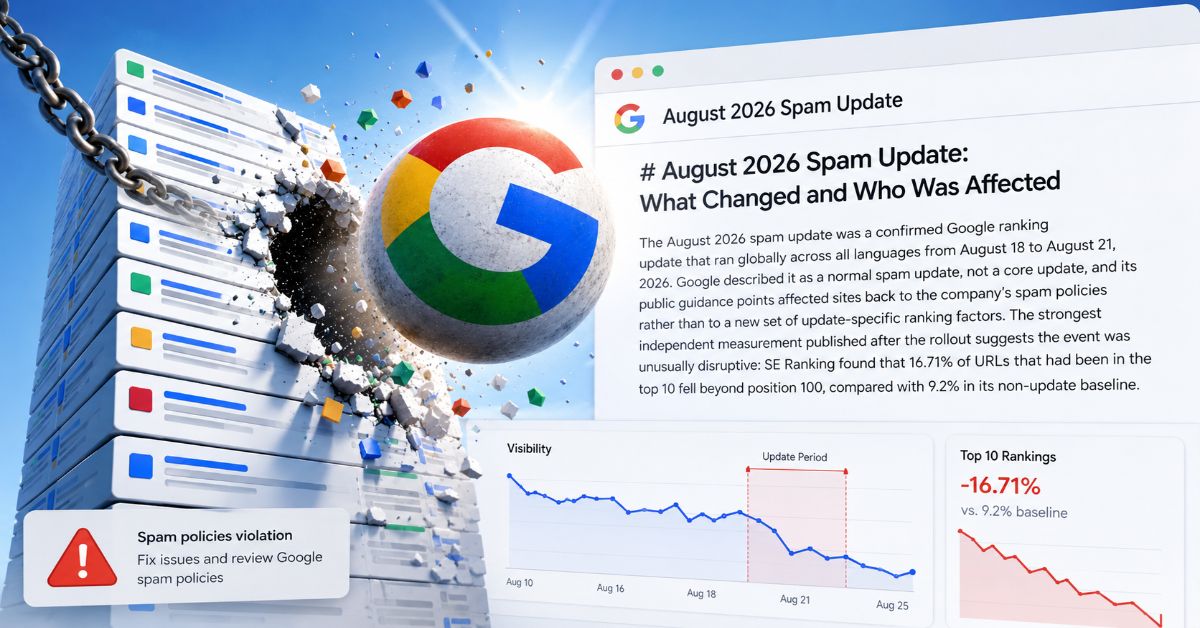
The August 2026 spam update was a confirmed Google ranking update that ran globally across all languages from August 18 to August 21, 2026. Google described it as a normal spam update, not a core update, and its public guidance points affected sites back to the company’s spam policies rather than to a new set of update-specific ranking factors. The strongest independent measurement published after the rollout suggests the event was unusually disruptive: SE Ranking found that 16.71% of URLs that had been in the top 10 fell beyond position 100, compared with 9.2% in its non-update baseline. The practical answer is that sites with sharp losses should investigate policy compliance and page-level ranking patterns, but they should not assume every August traffic decline was caused by this update.
I read this rollout as a case where the dates are simple but the diagnosis is not. Google’s Search Status Dashboard records a 2-day, 16-hour event, yet search volatility was already elevated before August 18 and continued after August 21. John Mueller also said the pre-announcement movement was not an early phase of the announced rollout. That means a responsible audit has to separate the confirmed update window from other ranking changes, seasonality, technical problems, demand shifts, and the changing way Google surfaces results through AI features. For site owners, publishers, in-house teams, and agencies, the useful question is not simply “was I hit?” It is “what changed, on which queries and pages, at what time, and does the pattern line up with a spam-policy issue?” The rest of this analysis follows that evidence-first approach, using Google’s documentation, third-party volatility reporting, and a large SE Ranking study while making clear where Google has not disclosed the mechanism.
What does the August 2026 spam update mean for site owners and SEOs?
The August 2026 spam update means that Google refreshed or improved automated systems used to identify search spam, and sites that lost visibility should first test whether their content or promotion methods conflict with Google’s spam policies. Google’s own spam update guidance says its automated spam-detection systems operate continuously and are periodically improved in notable ways that Google labels as spam updates. The same guidance says sites that see changes after one of these updates should review the spam policies and understand that recovery can take time while automated systems reassess compliance.
For a site owner, the immediate task is measurement rather than emergency editing. Start by checking whether the meaningful decline actually begins inside the August 18 to August 21 rollout window. The AlgoUpdateTimes Update Impact Checker is a useful internal starting point for matching the first date of a traffic or ranking change against confirmed Google update dates. Then verify the pattern in Google Search Console by comparing clicks, impressions, average position, page groups, query groups, countries, devices, and search appearance. A genuine update-related loss usually produces a coherent pattern across relevant pages or query clusters. A single page disappearing because of an indexing issue, canonical change, migration error, robots rule, or accidental noindex can look dramatic in analytics but requires a very different fix.
SEOs should also resist the temptation to label any poor result as a “penalty.” Google distinguishes automated ranking systems from manual actions. A spam update can cause algorithmic demotion or loss of visibility without a manual-action message. Conversely, a manual action is a separate process and is surfaced in Search Console. Google’s traffic-drop debugging guidance explicitly tells site owners to check both algorithmic updates and spam issues while also investigating technical changes, seasonality, security problems, and broader demand shifts.
The editorial takeaway for this site is straightforward. Use the Algorithm Updates archive to keep the confirmed timeline separate from speculation, and use the Ranking Recovery section for diagnosis and remediation. That separation matters because a recovery plan built on the wrong cause can waste weeks and sometimes make the site less stable.
What did Google confirm about the August 2026 spam update?
Google confirmed four core facts: it was a spam update, it started on August 18, it applied globally and to all languages, and the rollout completed on August 21 after 2 days and 16 hours. The company did not publish a companion technical breakdown explaining which spam classifier, policy category, or vertical changed most.
Google’s ranking history records the August event as the third named spam update of 2026, following the March and June spam updates. Search Engine Land reported the launch at roughly 12:30 p.m. Eastern on August 18 and completion at about 4:50 a.m. Eastern on August 21. Search Engine Roundtable likewise reported that Google described it as a “normal spam update,” a useful detail because it argues against treating the event as a specifically announced link-spam update.
The confirmed rollout timeline is compact enough to summarize precisely.
| Item | Confirmed detail | Source |
| Update name | August 2026 spam update | Google Search Status Dashboard |
| Rollout start | August 18, 2026, about 12:30 p.m. ET | Google dashboard and industry coverage |
| Scope | Global and all languages | Google announcement |
| Rollout end | August 21, 2026, about 4:50 a.m. ET | Google dashboard and industry coverage |
| Duration | 2 days, 16 hours | Google Search Status Dashboard |
| Specific spam target disclosed | No specific classifier or policy category named | Google and published coverage |
Those dates are important because August had substantial ranking movement outside the confirmed window. Search Engine Roundtable documented volatility on August 1 to 3, August 5 to 6, and August 12 to 13 before the spam update was announced. That earlier movement may have been real, but Google did not identify it as part of this spam rollout.
John Mueller, a Search Advocate at Google, addressed exactly that timing problem when a user suggested updates might begin several days before they are announced. Mueller said: “We don’t roll them out beforehand. We try to get the announcement as close as possible to the actual button-pushing.” His statement matters because it gives analysts a cleaner boundary. Traffic changes that clearly began days before August 18 should not automatically be retrofitted into the August 2026 spam update narrative.
How disruptive was the August 2026 spam update?
The best public dataset released after the rollout indicates that ranking disruption was materially greater than a comparable period without a confirmed Google update. Search Engine Land reported SE Ranking’s analysis of the same 100,000 U.S. keywords across 20 industries, comparing August 17 with August 22 and using July 26 to July 31 as a baseline period.
The study’s headline number is severe. During the update window, 16.71% of URLs that had ranked in the top 10 dropped beyond position 100 for the same keyword. In the July baseline, 9.2% did so. That represents an 82% increase in the drop-out rate, meaning a previously top-10 URL was about 1.8 times as likely to disappear beyond the tracked top 100 during the update comparison.
SE Ranking also found more aggressive movement into the highest positions. The percentage of post-update top-three URLs that had not previously ranked in the top 20 increased by 12%. Across the 20 industries in the dataset, top-10 volatility ranged from 74.64% in real estate to 85.55% in fashion and beauty. Search Engine Land noted that YMYL categories including real estate and healthcare were among the steadier groups, even though volatility was broad across every tracked niche.
The main published measurements are below.
| Metric | Observed result | Comparison or scope |
| Previously top-10 URLs falling beyond position 100 | 16.71% | 9.2% in the July baseline, an 82% increase |
| Relative likelihood of top-10 URL falling beyond top 100 | About 1.8 times | Update window versus baseline |
| Post-update top-three URLs previously outside top 20 | 12% increase in the measured share | Before-and-after comparison |
| Top-10 volatility range by industry | 74.64% to 85.55% | Real estate to fashion and beauty across 20 industries |
| Dataset | 100,000 U.S. keywords | August 17 versus August 22; July 26 versus July 31 baseline |
| Tracking limit | Positions 1 through 100 | Cannot distinguish deindexing from a fall below position 100 |
These numbers support the conclusion that the update coincided with exceptional churn. They do not support a claim that Google “targeted fashion,” “protected healthcare,” or punished a particular CMS, affiliate model, AI tool, link type, or publishing format. SE Ranking did not conduct URL-level or domain-level analysis of the winners and losers, and it tracked positions 1 through 100. A URL that vanished from that range may have been deindexed, may have fallen to position 101 or lower, or may have been displaced for reasons the dataset cannot identify.
Why industry-wide volatility cannot identify individual winners and losers
Industry averages are useful for establishing that the SERPs were moving more than normal, but they are poor evidence for diagnosing one website. A fashion site that fell during the most volatile category could have a spam-policy issue, a technical problem, a weaker product set, an internal-linking change, a demand shift, or simply a competitor that improved. Conversely, a healthcare site can be hit even if the healthcare category was comparatively stable in the study.
This is why ranking-update analysis should move from broad to narrow. First establish whether the market moved. Then compare your own visibility against direct competitors. Then isolate the affected page templates, query intents, and content types. Finally, review the practices that produced those pages and their links. The deeper the analysis becomes, the less useful it is to keep citing the category-wide volatility figure as if it were a diagnosis.
What likely changed inside Google’s spam systems?
Google has not disclosed the specific classifier or spam policy category adjusted in the August 2026 spam update, so the safest conclusion is that the rollout improved its automated spam-detection systems without a public statement naming one target. Google’s spam-update documentation gives SpamBrain as an example of an AI-based spam-prevention system that is improved over time, but that documentation does not say the August rollout was exclusively or specifically a SpamBrain update.
That distinction is important. The search industry often tries to reverse-engineer an update from the sites that lose visibility, but Google’s public documentation deliberately frames spam updates around policy compliance rather than a checklist of signals. The current Google spam policies cover practices including cloaking, keyword stuffing, link spam, machine-generated traffic, malware and malicious behavior, misleading functionality, scaled content abuse, scraping, site reputation abuse, thin affiliation, user-generated spam, and policy circumvention. Google can act against other spam patterns it detects as well.
In May 2026, Google also clarified that its spam policies apply to attempts to manipulate generative AI responses in Google Search. Semrush noted this context in its August update coverage, while also stressing that Google did not say the August spam update specifically targeted manipulation of AI Overviews or AI Mode. That is the right way to frame it: the policy scope is broader in 2026, but the update target is undisclosed.
Scaled content abuse is about purpose and value, not simply AI use
A common mistake is to translate “spam update” into “AI-content update.” Google’s policy language is more specific. Scaled content abuse concerns producing many pages primarily to manipulate search rankings rather than help users. The method of production can involve generative AI, human writers, automated transformations, or a mixture of methods. The core issue is whether the scaled output exists to game search systems and whether it offers original, useful value.
For publishers, that means the audit should examine editorial intent and page-level substance. Are hundreds of pages built from the same thin template? Do they answer slightly different keyword variants without adding different information? Are summaries merely rewritten from other sites? Do location pages exist without local expertise? Are product or comparison pages assembled from merchant feeds with minimal testing or analysis? Those patterns deserve more attention than whether a drafting tool was used somewhere in the workflow.
Scraping and thin affiliation remain high-risk patterns
Google’s spam policies define abusive scraping as taking content from other sites and republishing it with little or no original value, including lightly modified copies. Thin affiliation similarly covers affiliate pages that mainly reproduce merchant descriptions or distributed network content without substantial additional usefulness. These policies are especially relevant after a spam update because a site can look “content rich” by page count while providing little independent information.
A recovery review should therefore look for evidence of first-hand testing, original data, expert interpretation, clear sourcing, comparison methodology, unique media, and real editorial judgment. This is also where the SEO Basics section can support foundational cleanup, because strong technical hygiene and clear site structure make it easier to separate a quality problem from an indexing or crawling problem.
Site reputation abuse is a separate policy issue with a fresh August change
Google updated its site reputation policy on August 28, 2026, one week after the spam rollout finished. Beginning August 30, manual actions under that policy will have a different effect for users in the European Economic Area than for users elsewhere. Outside the EEA, the affected part of a site can be directly impacted in results. Inside the EEA, Google says the manual-action impact will not apply; the relevant section may instead be separated in Google’s systems so it can rank independently over time.
That policy change is important current context, but it should not be presented as proof of what the August 18 spam update targeted. The August 28 announcement concerns enforcement of a specific manual-action policy and the EEA. The August 18 event was a global automated spam update. Mixing the two would blur exactly the distinction an evidence-led article should preserve.
Was the ranking volatility before August 18 part of the spam update?
No. Google’s public position is that it does not begin a named update several days before announcing it, and John Mueller specifically rejected that interpretation during the August rollout. Search Engine Roundtable had documented noticeable ranking volatility on several dates earlier in August, but Mueller’s statement means those movements should be treated as separate from the confirmed spam update unless Google later says otherwise.
This matters for Search Console analysis. Suppose a site’s clicks began declining on August 12, lost another 10% on August 15, and then stabilized through August 18 to 21. It would be misleading to call the whole decline an “August spam update hit” merely because the dates are close. The more accurate conclusion is that the site experienced pre-update volatility, with no clear evidence that the confirmed spam rollout added a second loss.
The opposite pattern is more suggestive. If a stable site drops sharply on August 19 or August 20 across a coherent group of commercial pages, and direct competitors gain on the same queries, the timing is more consistent with the update window. Even then, timing establishes correlation, not the exact spam policy that triggered the shift.
Analysts should also remember that Google continuously makes smaller ranking changes. The status dashboard lists notable events, not every adjustment to Search. A date that sits outside a named update is therefore not a “no-change” period. It is simply a period without a confirmed notable ranking event on the dashboard.
Why did ranking volatility continue after the rollout ended?
Post-rollout volatility was real enough to be documented by multiple tracking tools and SEO community reports, but Google had not announced another ranking update as of August 29, 2026. Search Engine Roundtable reported continued movement after August 21 and showed data sources from AccuRanker, Advanced Web Ranking, MozCast, Semrush, SISTRIX, Similarweb, and other trackers.
There are several plausible explanations, and none should be upgraded to fact without confirmation. First, the visible consequences of a completed system rollout can continue to surface as Google recrawls pages, recalculates signals, and users encounter refreshed SERPs. Second, Google can make smaller unannounced changes that are separate from the named update. Third, query mixes, news cycles, AI-result layouts, competitor changes, and indexing events can produce apparent “volatility” even after the official incident closes.
Different trackers can also tell different stories because they sample different keywords, locations, devices, and SERP features. SISTRIX’s update log confirms the August 18 to August 21 spam event. A separate AirPulse analysis of public tracker series reported relatively calm average readings during the official rollout for Semrush Sensor and AccuRanker Grump, while SE Ranking’s before-and-after study found unusually large URL displacement. Those findings are not necessarily contradictory. One dataset measures aggregate daily movement in its own sample; another compares whether specific URLs remained within ranking bands across selected dates.
For practitioners, this is a reminder to understand what a volatility chart actually measures. A market-level sensor is useful for answering “is Google unusually turbulent today?” It is not automatically a substitute for your tracked keyword set, and it cannot tell you whether your specific decline was caused by spam classification.
Which sites and industries were affected by the August 2026 spam update?
The update applied globally and to all languages, and SE Ranking recorded broad top-10 volatility across all 20 industries in its U.S. keyword sample. Beyond that, there is not enough public evidence to name a definitive list of affected site types or to identify a single vertical as the update’s target.
The broadest measured range was 74.64% top-10 volatility in real estate and 85.55% in fashion and beauty. Healthcare and real estate, both YMYL categories, were among the steadier verticals in the dataset. Yet “steadier” is relative. A category can have the lowest volatility in a high-volatility event and still contain individual sites with large gains or losses.
Publishers should pay particular attention to scaled, derivative, or weakly differentiated content inventories because those patterns map directly to existing spam-policy language. Affiliate sites should inspect whether pages add substantial comparison, testing, or decision support beyond merchant feeds. Large marketplaces and user-generated platforms should audit whether spam can enter at scale through profiles, forums, uploads, subdomains, or templated landing pages. Agencies should review whether link-building, expired-domain strategies, programmatic page generation, or third-party content partnerships create risk under current policies.
At the same time, it would be wrong to treat a ranking loss as proof that a site was “spam.” Google’s own Q&A on search updates has long cautioned that search changes need diagnosis, and the third-party August dataset does not identify why individual pages moved. A legitimate site can lose positions because competing pages become relatively stronger, because query intent changes, or because another unannounced system adjustment overlaps the same period.
The phrase “who was affected” therefore has two levels of answer. At the market level, every tracked industry saw churn and the rollout was global. At the site level, only a page-by-page and query-by-query audit can establish what actually changed for a given domain.
How should you diagnose a traffic drop after the August 2026 spam update?
Diagnose an August decline by establishing timing, scope, search surface, and policy risk in that order. Do not start by deleting pages, disavowing links, changing templates, or rewriting everything. A disciplined sequence preserves evidence and makes it easier to tell whether a later recovery came from your changes or from the market settling.
Step 1: Confirm the date and the search surface
Use daily Search Console data around August 10 to August 28 rather than comparing only monthly totals. Mark August 18 as the rollout start and August 21 as the completion date. Then separate Web, News, Discover, Image, and other available search appearances where relevant. A Discover decline, for example, should not automatically be interpreted through the same lens as a Web Search ranking loss.
Check whether clicks fell because impressions dropped, because average positions deteriorated, because click-through rate changed, or because demand fell. A rankings issue usually shows a position and impression pattern. A SERP-layout shift can reduce clicks even when position is stable. Seasonality can reduce both your traffic and competitors’ traffic without any ranking penalty.
Step 2: Segment by page type and query intent
Group URLs into meaningful templates: editorial articles, category pages, product pages, location pages, comparison pages, user-generated pages, programmatic pages, and any third-party-hosted sections. Then group queries by intent or topic. A sitewide average can hide the fact that one large template lost most of the visibility while the rest of the site was stable.
Next, identify whether losses are concentrated in pages that share a risky production pattern. If thin location pages, mass-generated comparisons, copied specifications, or lightly edited syndicated content fell while original editorial pages held steady, that pattern is more actionable than a generic “domain traffic down 28%” statement.
Step 3: Compare direct competitors and SERP replacements
For each important lost query, record which URLs replaced you. Do the winners provide more original information, stronger first-hand evidence, better task completion, clearer authorship, or a more direct answer? Are they large domains using third-party content, small specialists, ecommerce pages, forums, or first-party sources? The answer can reveal a change in result composition even when it does not prove the ranking system responsible.
Do not only study winners. Examine pages on your own site that held or gained. Internal controls are extremely valuable because they share the same domain authority, technical stack, brand, and much of the same backlink profile. Differences between your own winners and losers can expose template-level or editorial-level weaknesses faster than an external competitor study.
Step 4: Check Search Console for manual actions, security, and indexing problems
Google’s debugging guidance recommends checking the Manual Actions report and Security Issues report when spam or security is suspected. Also inspect indexing status for affected URLs, canonical selection, robots directives, redirects, server errors, and recent migrations. A sudden indexation problem can mimic an algorithmic drop, and a spam update should not become an excuse to overlook basic technical evidence.
Step 5: Build a policy-risk inventory
Map suspect page groups against Google’s actual policy categories. Look for scaled content abuse, scraping, thin affiliation, keyword stuffing, cloaking, link spam, misleading functionality, user-generated spam, site reputation abuse, and policy circumvention. Record the evidence for each risk. A binary “compliant/noncompliant” column is less useful than documenting what the page does, why it exists, who created it, what unique value it adds, and how users reach it.
The objective is to produce a diagnosis that another experienced SEO could reproduce. If your conclusion depends on “it feels like Google dislikes this niche,” it is not yet strong enough.
What should affected sites do to recover?
Sites that believe they were affected should remove or substantially improve practices that conflict with Google’s spam policies, then allow time for Google’s automated systems to reassess the site. Google’s spam-update guidance says changes may help if automated systems learn over a period of months that a site complies with the policies. That wording is important because it sets expectations: recovery is not necessarily tied to the next announced spam update and may not happen immediately after a cleanup.
A strong recovery plan starts with the clearest violations or weakest value propositions, not with cosmetic SEO adjustments. If a page exists mainly because a keyword tool showed search volume and the page adds little beyond information already available elsewhere, decide whether it can become genuinely useful. If not, consolidation or removal may be better than another rewrite. If a page is valuable but thin, add original research, first-hand testing, expert commentary, transparent methodology, or tools that materially improve task completion.
For scaled content, reduce duplication across templates and make sure each page earns its existence. A programmatic approach is not inherently prohibited, but thousands of pages built primarily to capture query variants can create risk when the user value is minimal. Review prompts, source data, editorial checks, and publishing thresholds. The question is not “was AI used?” It is “would this page still deserve to exist if search engines sent no traffic?”
For affiliate content, replace copied merchant descriptions with independent analysis. Explain how products were selected, what was tested, which trade-offs matter, and who each option is for. Disclose commercial relationships clearly. Google’s thin-affiliation policy specifically distinguishes low-value reproduction from affiliate pages that add meaningful reviews, testing, navigation, comparisons, or other benefits.
For link issues, avoid reflexively using the disavow tool simply because rankings dropped during a spam update. Google did not announce the August event as a link-spam update. Audit manipulative link acquisition if you have reason to believe it exists, but do not manufacture a link diagnosis from timing alone. Search Engine Roundtable reported that Google characterized the rollout as a normal spam update and did not identify link spam as the specific target.
For third-party content, audit ownership, editorial control, integration, authorship, and the reason the content is hosted on the domain. Google’s August 28 site reputation policy update makes this particularly timely. The central concern is not merely that a freelancer, partner, or outside organization contributed content. The concern is publishing third-party content mainly to exploit the host site’s established ranking signals.
Finally, document every substantial remediation. Keep before-and-after URL inventories, publication dates, noindex decisions, redirects, content consolidations, link removals, and editorial-policy changes. Recovery work often spans months, staff changes, and multiple Google updates. A clean log prevents teams from repeating failed experiments or falsely crediting the last change made before traffic returns.
What should agencies and in-house SEO teams report to stakeholders?
Stakeholders need a timeline, evidence, risk assessment, and next actions, not a dramatic update label. The first slide or memo should state that Google’s August 2026 spam update ran August 18 to August 21 globally, followed by whether the organization’s measured decline began inside that window. If it did not, say so explicitly.
Next, quantify the loss in business terms. Separate clicks, conversions, revenue, leads, Discover traffic, branded demand, and non-branded rankings. A 20% organic traffic decline can be commercially minor if it is concentrated in low-intent informational pages, or severe if it removes high-value product and lead-generation queries. The update label should never replace impact analysis.
Then show confidence levels. For example: high confidence that the timing overlaps the update; medium confidence that scaled comparison pages are disproportionately affected; low confidence about whether link signals contributed. This prevents teams from presenting hypotheses as facts. It also creates a clear path for what evidence would raise or lower confidence.
A useful report also tracks what did not change. If crawling remained healthy, branded queries held steady, index coverage was normal, and only one content template lost non-branded visibility, those negatives narrow the search space. Good incident analysis is as much about ruling out causes as naming them.
How does the August spam update compare with Google’s other 2026 ranking updates?
The August spam update was short compared with the 2026 core updates and slightly longer than the June spam update. Google’s ranking history shows three named spam updates in 2026 through August 29, plus two core updates and a February Discover update.
The comparison below uses Google’s own incident history.
| Update | Start date | Duration |
| February 2026 Discover update | February 5, 2026 | 21 days, 17 hours |
| March 2026 spam update | March 24, 2026 | 19 hours, 30 minutes |
| March 2026 core update | March 27, 2026 | 12 days, 4 hours |
| May 2026 core update | May 21, 2026 | 11 days, 21 hours |
| June 2026 spam update | June 24, 2026 | 2 days, 1 hour |
| August 2026 spam update | August 18, 2026 | 2 days, 16 hours |
The durations reinforce why teams should not use a single standard waiting period for every Google update. The May core update ran nearly 12 days, the March core update ran just over 12 days, and the February Discover update ran more than 21 days. By contrast, the March spam update lasted under a day, the June spam update about two days, and the August spam update 2 days and 16 hours.
A shorter rollout does not necessarily mean a smaller ranking impact. SE Ranking’s August measurements show that a compact window can still coincide with major displacement. Duration tells you how long Google says the rollout took, not how severe the effect will be for a particular site.
The 2026 sequence also shows why maintaining an internal update log matters. A site that declined in late May, partially recovered in July, and dropped again on August 19 may have multiple causes across a core update and a spam update. Treating the full six-month chart as one event can lead to the wrong remediation plan.
What happens next after the August 2026 spam update?
As of August 29, 2026, the August spam update is complete and Google’s Search Status Dashboard shows no active ranking incident. The next sensible step is observation combined with targeted cleanup, not waiting passively for another announcement and not assuming every day of volatility is a hidden continuation of the spam update.
Post-update monitoring should focus on three things. First, watch whether affected page groups stabilize, continue declining, or begin recovering. Second, monitor whether Google announces another notable ranking event that overlaps your remediation period. Third, track whether SERP composition changes in ways that affect clicks even without ranking loss, particularly as AI Overviews and AI Mode evolve.
The August 28 site reputation policy change also becomes operational on August 30 for relevant manual actions in the EEA. Publishers with third-party sections should understand that this is a separate policy enforcement development, not an extension of the completed August spam rollout. It nevertheless belongs on the same risk calendar because it affects how certain policy actions can change search visibility across regions.
For AlgoUpdateTimes readers, the most useful ongoing practice is to combine confirmed update dates with site-specific evidence. A public tracker tells you when the ecosystem is moving. Search Console tells you whether your site moved. Your content and policy audit tells you why it may have moved. Keeping those layers separate is the best defense against false certainty.
Conclusion: what should SEOs watch now?
The August 2026 spam update is finished, but its aftermath is still worth measuring. The strongest independent dataset published so far shows unusually high URL displacement, while Google’s own communication remains deliberately broad: this was a global spam update, and affected sites should review the spam policies. The evidence does not justify naming a single targeted vertical or tactic.
For most teams, the best next move is a controlled audit. Confirm the loss date, segment affected URLs and queries, compare SERP replacements, check Search Console for technical and manual-action signals, and map the weakest page groups to specific policy risks. Improve or remove content that exists mainly to manipulate search demand, strengthen pages that can genuinely serve users, and document each change.
That approach may feel slower than chasing a theory from social media, but it produces decisions that survive the next update. Google’s systems keep changing, and the search results are now influenced by more surfaces and formats than a traditional ten-blue-links model. The durable advantage is not predicting every classifier. It is operating a site whose value, provenance, editorial control, and technical health are clear enough that ranking changes can be investigated with evidence instead of guesswork.
Frequently Asked Questions
Is the August 2026 spam update still rolling out?
No. Google’s Search Status Dashboard records the rollout as completed on August 21, 2026, after 2 days and 16 hours. Ranking volatility observed after that date is not currently listed by Google as the same active incident.
Did the August 2026 spam update specifically target link spam?
Google did not announce it as a link-spam update. Search Engine Roundtable reported that Google described it as a normal spam update, so link spam should be audited when there is evidence of manipulative linking, not assumed from the update name alone.
How long can recovery from a spam update take?
Google says improvements may help once its automated systems learn over a period of months that a site complies with spam policies. Recovery timing therefore varies and is not guaranteed to coincide with the next announced update.
Were AI-generated sites specifically targeted?
Google has not said the August 2026 spam update specifically targeted AI-generated content. Its spam policies apply to manipulative scaled content and to attempts to manipulate generative AI responses, but the company did not disclose an August target centered on AI authorship.
Can a legitimate site lose rankings during a spam update?
Yes, a legitimate site can lose rankings during the same period for reasons that are not proven to be spam classification. Diagnose timing, page groups, competitors, indexing, demand, and policy risks before assigning a cause.
Sources
The following sources were used for factual claims, dates, policy interpretation, and ranking-impact analysis in this article.
Google Search Status Dashboard – official ranking incident history, rollout dates, durations, and 2026 update sequence.
Google Search Central spam update guidance – how spam updates work, SpamBrain context, compliance guidance, and recovery timing.
Google Search spam policies – current definitions for scaled content abuse, scraping, thin affiliation, link spam, site reputation abuse, and other prohibited practices.
Google Search traffic-drop debugging guidance – diagnostic workflow covering algorithmic changes, spam issues, technical causes, seasonality, and Search Console checks.
Google Search documentation updates – 2026 clarification that spam policies also apply to attempts to manipulate generative AI responses in Google Search.
Google Search Central site reputation policy update – August 28, 2026 EEA enforcement change that begins August 30 and is separate from the spam rollout.
Search Engine Land impact analysis – SE Ranking study of 100,000 U.S. keywords across 20 industries and published volatility measurements.
Search Engine Land rollout completion report – completion timing and Google rollout wording.
Semrush August 2026 spam update analysis – 2026 policy context, global scope, and guidance on separating update effects from other visibility shifts.
Search Engine Roundtable on update timing – John Mueller statement that named updates are not rolled out days before announcement.
Search Engine Roundtable post-rollout volatility report – continued volatility after August 21 and tracker coverage.
SISTRIX Google Updates – independent update log confirming August 18 to August 21 timing.
AirPulse tracker analysis – comparison of public Semrush Sensor and AccuRanker series during the rollout.