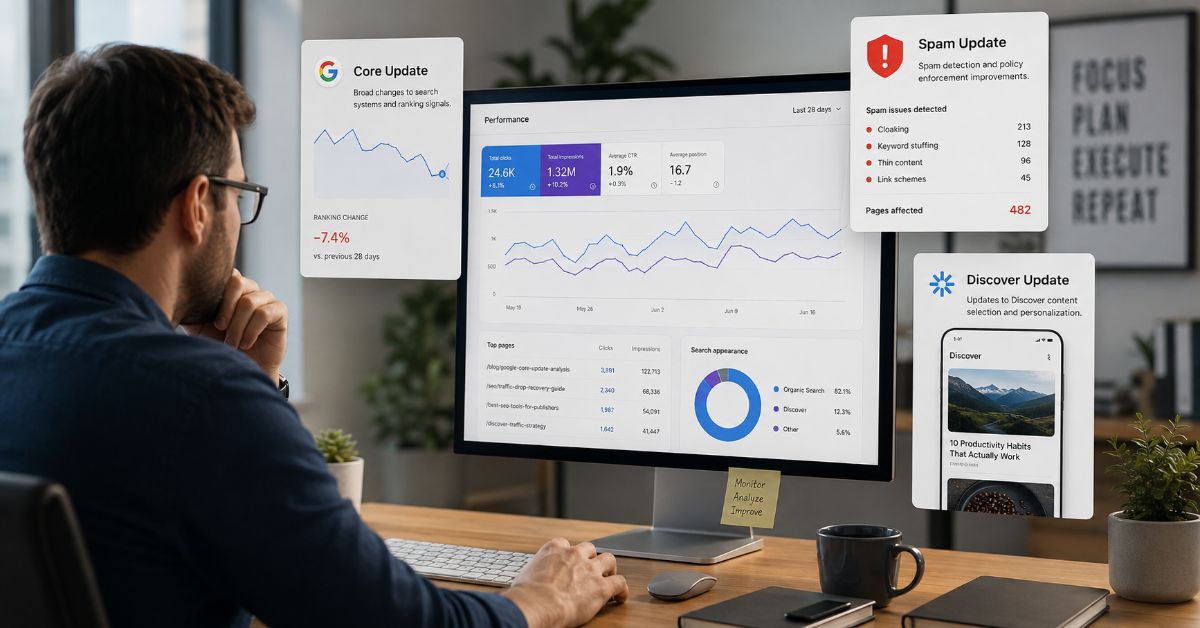
The main types of Google updates that site owners need to distinguish are core updates, spam updates, and Discover updates. Core updates broadly recalibrate Google’s ranking systems, spam updates improve enforcement against manipulative practices, and Discover updates change how content is selected or surfaced in the personalized Discover feed. The label matters because the right diagnosis changes what you should inspect, what data you should trust, and whether a rapid fix is even possible. I treat the announcement type as the starting hypothesis, not the final diagnosis, because Google runs many systems continuously and traffic can move for unrelated reasons. A site can also gain in one surface while losing in another. Google says core changes are broad rather than targeted at individual sites, while spam systems can reduce or remove visibility for policy-violating content. Discover is different again: it is an extension of Search, but its recommendations depend heavily on user interests and can fluctuate even when traditional Search visibility remains stable.
This distinction matters in 2026 because Google’s public update history shows several rollout types in a short period. The February 2026 Discover core update ran from February 5 to February 27 for English-language users in the United States. A March spam update was followed days later by a March core update, another core update began May 21, spam updates followed in June and August, and Google marked the August 2026 spam rollout complete on August 21. That sequence is a reminder that ‘an algorithm update’ is not one thing. I would not respond to a Discover decline by rewriting an entire site as though it had failed a broad core assessment, and I would not treat a spam-related loss as ordinary volatility without reviewing the relevant policies. This guide gives site owners, in-house SEOs, publishers, and agencies a repeatable way to separate these update classes, validate timing in Search Console, interpret rank-tracker data carefully, and choose a response that matches the evidence rather than the anxiety of a traffic graph moving down.
How the types of Google updates differ in practice
The simplest distinction is scope and intent: core updates adjust broad ranking systems, spam updates strengthen systems that detect policy violations, and Discover updates change the recommendation environment for Discover traffic. The categories can overlap in timing, but they are not interchangeable labels. Google describes its ranking stack as many automated systems that evaluate signals across hundreds of billions of pages and other content. Some systems are part of the core ranking infrastructure, while others handle specific ranking needs. That framework explains why an announced update should be read as a change to a class of systems rather than as a single switch that targets one niche or one website.
A core update is therefore best understood as a broad reassessment of how Google’s central ranking systems weigh and combine signals. A spam update is narrower in purpose because Google says it reflects notable improvements to automated spam detection, including SpamBrain. A Discover update is surface-specific: it concerns the feed where Google recommends content to users without a conventional typed query. In February 2026, Google explicitly called its rollout a Discover core update and limited the initial release to English-language users in the United States, with possible expansion to other countries and languages later. That is unusually clear evidence that a ‘core’ concept can be applied within a specific Search surface while still being operationally different from a general Search core update.
For day-to-day SEO work, the announcement label should control the first audit branch. With a core update, compare the pages that moved against competing pages and assess usefulness, originality, intent satisfaction, site trust, and whether your improvements are substantial rather than cosmetic. With a spam update, begin with policy exposure: scaled content abuse, cloaking, doorway abuse, site reputation abuse, link spam, hacked content, or other manipulative patterns. With Discover, segment the Discover report from Web Search performance and evaluate content eligibility, topical interest, headline and image quality, freshness, and audience demand before concluding that the entire domain has a ranking problem.
This comparison table summarizes the practical differences before the deeper sections below.
| Update type | Primary purpose | Typical scope | Best first data check | First response |
| Core update | Improve broad ranking quality and relevance | General Search ranking systems, sometimes many systems together | Search Console Web performance by page and query | Compare lost pages with winners and make substantive quality improvements |
| Spam update | Improve detection of manipulative or policy-violating practices | Global or targeted spam systems and policies | Search Console plus spam-policy and manual-action review | Remove or redesign practices that violate spam policies |
| Discover update | Improve content selection and quality in Discover | Discover recommendation surface, sometimes limited by language or country | Search Console Discover performance | Segment Discover from Search and review audience, topic, freshness, headline, and image factors |
What is a Google core update?
A Google core update is a significant, broad change to the systems that rank Search results, intended to improve overall relevance and usefulness rather than punish a specific site. Google’s current core update guidance says these broad changes happen several times a year, while smaller core changes can also occur continuously without public announcements. That point matters because a recovery can happen outside the next named rollout if Google reprocesses improved signals and smaller changes favor the site.
Google’s core update documentation also discourages the classic SEO reflex of chasing one rumored factor. The company advises site owners to avoid quick fixes and instead make changes that are sustainable for users. It treats deletion as a last resort, particularly when content can be improved. That guidance aligns with the architecture described in Google’s ranking systems guide: page-level systems are important, but site-wide signals and classifiers can also contribute to how pages are understood. A drop across one template or topic cluster may therefore have a different cause from a broad site decline, even when both happen during the same rollout window.
The 2026 timeline shows what a modern core rollout looks like in practice. Google’s Search Status Dashboard records the May 2026 core update as beginning May 21 and ending June 2, a duration of 11 days and 21 hours. SISTRIX reported that its update radar, which tracks movement across one million SERPs per day, detected substantial movement during that period and published examples of large visibility changes among both winners and losers. Those examples do not prove why any individual domain changed, but they demonstrate why a broad core update can look very different across sectors and countries.
Core updates also absorb ideas that once had separate names. Google’s ranking systems guide now lists the helpful content system as retired in its former standalone form because, in March 2024, it evolved into part of the core ranking systems. Panda became part of core systems in 2015, and Penguin was integrated in 2016. This history is important for anyone searching for a neat list of named updates: Google’s public vocabulary changes as systems mature. The durable distinction is not the old brand name. It is whether Google is describing a broad core ranking change, a spam enforcement improvement, or a change tied to a specific surface or system.
The March 2024 core update is a useful case study in complexity. Google said it involved multiple core systems and warned that ranking fluctuations could be greater than with a regular core update as different systems updated and reinforced one another. In a related announcement, Elizabeth Tucker, Google’s Director of Product Management, reported that the completed work produced “45% less low-quality, unoriginal content” in results compared with the pre-update baseline. That statement should not be read as a site-level threshold. It describes Google’s aggregate evaluation of search quality, but it shows that core changes can incorporate multiple quality systems rather than a single ranking factor.
How should you diagnose a possible core update hit?
Start with dates, segmentation, and page groups. Confirm that the decline begins inside the official rollout window, then compare Web Search clicks, impressions, average position, query groups, directories, content types, and countries. Do not treat a same-day traffic decline as proof of causation. Seasonality, demand shifts, SERP feature changes, tracking problems, migrations, indexation changes, and competitor improvements can all create a graph that resembles an algorithmic hit.
Next, review the pages that lost the most meaningful queries and compare them with the pages that replaced them. The useful question is not ‘what did Google penalize?’ but ‘what is Google now preferring for this intent?’ Look for differences in information gain, first-hand detail, source quality, completeness, page purpose, user experience, authorship transparency, and whether the winning pages answer the query more directly. John Mueller, Search Advocate at Google Switzerland, wrote during the August 2024 core update that Google aimed to surface more “useful, original content” from a range of sites. That is a better editorial target than trying to reverse engineer one secret factor.
What is a Google spam update?
A Google spam update is a notable improvement to the automated systems Google uses to detect search spam and enforce its spam policies. Google says those systems operate continuously, but it announces some major improvements when they are likely to matter to site owners. SpamBrain is Google’s named AI-based spam-prevention system, and the spam update documentation specifically points to periodic improvements in how it detects old and new forms of manipulation.
The distinction from a core update is intent. A core update can move a perfectly compliant site because Google’s assessment of relevance, quality, or usefulness changes relative to competing results. A spam update is connected to behaviors that attempt to deceive users or manipulate ranking systems. Google’s current spam policies cover practices such as cloaking, doorway abuse, scaled content abuse, scraping, site reputation abuse, hidden text or links, hacked content, and link spam. A site affected by a spam update should therefore audit whether its publishing, linking, hosting, or monetization practices create genuine policy exposure, not merely whether a page ‘needs more words.’
The latest confirmed example as of August 29, 2026 is the August 2026 spam update. Google’s status dashboard shows that it began August 18 and finished August 21 after about two days and sixteen hours. Search Engine Land reported Google’s statement that the update applied globally and to all languages. The publication later cited SE Ranking data showing a sharp increase in severe ranking losses during the rollout: 16.71% of URLs that had ranked in the top 10 fell beyond position 100, compared with 9.2% in a comparable July baseline period. That third-party dataset covered 100,000 U.S. keywords across 20 industries. It is evidence of unusually disruptive movement, not proof that every large drop was a spam violation.
The June 2026 spam update offers another useful comparison. Google’s incident record says it started June 24 and completed June 26, also applying globally and to all languages. The short rollout illustrates why SEOs should not assume every update takes two weeks. Core rollouts frequently span roughly one to three weeks, but spam releases can finish much faster. The official start and completion timestamps are more reliable for attribution than a generic ‘Google update’ post circulating on social media.
What is the difference between an automated spam impact and a manual action?
An automated spam impact does not necessarily create a manual-action notification in Search Console. Google’s systems can algorithmically reduce the visibility of content that appears to violate spam policies. Manual actions are separate human-enforced actions that can be reported in Search Console and may have a reconsideration process. That distinction is critical. The absence of a manual action does not prove that spam systems had no role, while the presence of a manual action gives you a much more specific remediation path.
Link spam also has a special recovery caveat. Google’s spam update documentation explains that when systems neutralize the benefit of spammy links, cleaning up those links may not restore the old ranking advantage. The previous benefit itself was artificial. This is one reason a link-related decline can look like a permanent reset rather than a conventional penalty that rebounds after a cleanup.
What is a Google Discover update?
A Google Discover update changes how content is selected, ranked, or presented in Discover, the personalized feed that recommends content based on a user’s interests rather than a typed search query. Discover is connected to Google’s broader Search ecosystem, but its traffic behaves differently because demand is recommendation-driven. A publisher can lose Discover impressions without losing the same topics in Web Search, and the reverse can happen as well.
Google’s Discover documentation says that updates can sometimes produce traffic changes because Discover is an extension of Search. It also warns that sites can experience traffic changes unrelated to content quality or publishing frequency as Google continues to improve the Discover user experience. That sentence should influence how publishers respond. Discover is inherently less predictable than query-led Search because user interests, available stories, recency, language, geography, device context, and the competitive content pool can change rapidly.
The February 2026 Discover core update is the clearest recent example. Google’s Search Status Dashboard records the rollout from February 5 at 9:00 a.m. Pacific to February 27 at 2:00 a.m. Pacific. Google said the initial release was for English-language users in the United States and was designed to improve Discover quality overall, with possible expansion to other countries and languages later. The final duration was more than 21 days, longer than the initially suggested two-week window. That makes it a useful reminder that rollout estimates are not guarantees.
Search Console is the primary diagnostic source for this surface. Google’s Discover documentation says the Performance report can show impressions, clicks, and click-through rate for content that appeared in Discover during the last 16 months, provided the property reaches the required impression threshold. Publishers should compare this report with Web Search performance before making site-wide conclusions. If Discover clicks collapse but Search clicks, ranking queries, and indexed coverage remain steady, the problem is not automatically a broad core quality loss.
Why can Discover traffic fall while Google Search stays stable?
Discover has no explicit user query to anchor demand. It predicts what a person may want to see. That makes distribution sensitive to changing interests, news cycles, content freshness, image presentation, and the mix of competing content available to the feed. Search traffic is constrained by queries people actually type, so the same article can retain stable keyword rankings while receiving fewer recommendations.
For publishers, that means the correct response is usually portfolio-level rather than page-level panic. Review which topics lost impressions, whether the audience’s interests shifted, whether competitors produced stronger or more timely coverage, and whether your images and headlines accurately represent the content. Avoid clickbait. Discover guidance emphasizes content that is helpful, reliable, and compelling without misleading preview information. A short-term Discover fall does not justify rewriting evergreen pages that continue to satisfy searchers.
What this means for site owners, SEOs, and publishers
The operational lesson is to match the response to the update class before touching the site. A core update calls for comparative quality analysis. A spam update calls for a policy audit. A Discover update calls for surface-specific segmentation and editorial distribution analysis. When teams skip that classification step, they often waste the first week of an incident making changes that blur the evidence.
For site owners, the first priority is preserving a clean timeline. Record the date traffic changed, any releases or migrations, major content changes, tracking changes, and the official Google rollout window. Use the confirmed update history rather than memory. The live AlgoUpdateTimes Update Impact Checker can also serve as a quick internal reference point for matching a traffic-change date against confirmed core, spam, and Discover rollouts, but Search Console remains the source of truth for your own property data.
For in-house SEO teams, create separate views for brand and non-brand queries, key templates, countries, device classes, Web Search, Discover, and if relevant Google News. If a core update causes a broad reordering, the pattern often appears across multiple query clusters. If a spam update is involved, you may see sharper losses on sections with a common publishing or link pattern. If Discover is the driver, the Web Search view may remain surprisingly normal.
For agencies, the biggest discipline is resisting cross-client pattern matching too early. Five clients dropping during the same week may have five different causes. Use the official update window as a shared context, then validate each property independently. Third-party sensors are valuable for showing whether the wider SERPs are turbulent, but they cannot identify a client’s root cause by themselves.
How can you tell which Google update affected your site?
You can narrow the likely cause by combining official rollout dates, Search Console segmentation, the shape of the loss, and known policy exposure. No single signal is conclusive, but the combination can make one hypothesis much stronger than the others.
First, align the traffic change with Google’s Search Status Dashboard. Use the exact start and completion dates and remember that effects can appear in waves rather than at the first minute of a rollout. In the May 2026 core update, SISTRIX reported an early cluster of changes and then a second cluster nearly a week later in U.S. data. A delayed reaction can still be consistent with a core rollout.
Second, isolate the affected surface. In Search Console, compare Web Search and Discover rather than relying on total Google traffic in analytics. For Web Search, inspect clicks, impressions, average position, and query/page combinations. For Discover, inspect impressions, clicks, CTR, and content groups. If only Discover drops, start with a Discover hypothesis. If Web Search drops across many unrelated topics during a core rollout, investigate core quality and competitive changes. If the decline is concentrated in sections with questionable scaled publishing, repurposed third-party content, or manipulative link practices during a spam rollout, a policy hypothesis deserves priority.
Third, examine whether the movement is ranking loss, demand loss, or click loss. Rankings can remain stable while clicks decline because SERP layouts change or demand falls. Impressions can fall because fewer people search the topic. Average position can look stable when a site loses many long-tail queries but retains a few high-volume ones. Diagnose at query and page level before assuming an algorithmic demotion.
Fourth, compare winners. A competitor that gains can reveal the direction of the result set. If Google is replacing thin aggregations with primary sources, adding clearer local expertise, preferring stronger original reporting, or surfacing more authoritative product pages, that pattern is more actionable than a generic site audit checklist. The goal is to understand the result Google is trying to produce for users, not to copy the winning page word for word.
Use the table below as a triage matrix. It is a starting point, not proof of causation.
| Observed pattern | Core hypothesis | Spam hypothesis | Discover hypothesis | Best validation |
| Broad Web Search ranking losses across unrelated topics | Strong if timing matches rollout | Possible if common policy issue exists | Weak | Page/query comparison plus competitor review |
| Sharp losses concentrated in scaled or manipulative sections | Possible | Strong | Weak | Spam-policy audit and Search Console manual actions |
| Discover impressions collapse while Web Search stays stable | Weak | Weak unless policy issue is evident | Strong | Discover Performance report and topic-level analysis |
| Traffic loss with stable rankings and impressions | Weak | Weak | Possible | Demand, CTR, SERP layout, analytics, and seasonality checks |
| Large movement during known rollout with market-wide volatility | Moderate to strong depending on update type | Moderate to strong depending on update type | Moderate if Discover rollout | Official incident dates plus independent sensor data |
How should you respond after a core, spam, or Discover update?
The right response is evidence-led and update-specific. Do not change dozens of variables at once, because you will lose the ability to tell which improvements mattered. Keep a change log, prioritize the clearest weaknesses, and measure recovery across the same segments that first showed the decline.
After a core update, audit content quality at the page and section level. Improve pages where the intent has drifted, the information is derivative, key claims lack support, the author or organization is opaque, or competitors now answer the query more completely. Consolidate duplication when it genuinely helps users. Improve navigation and page experience when they create friction, but do not assume one Core Web Vitals score is the hidden reason for every ranking loss. Google’s guidance explicitly frames core updates as broad changes and recommends meaningful, sustainable improvements over quick fixes.
After a spam update, map the site against Google’s current spam policies. Look for scaled pages created primarily to capture search demand, scraped or lightly transformed content, third-party sections hosted mainly to exploit the domain’s established ranking signals, doorway patterns, cloaking, hidden links, unnatural linking, or hacked pages. If a business model depends on a practice Google now defines as spam, cosmetic edits are unlikely to solve the underlying problem. The remediation has to change the behavior itself.
After a Discover update, protect the parts of the site that still perform in Search. Analyze the Discover report, topic clusters, content age, headlines, large images, entity focus, and whether the content is timely enough for the feed. Do not turn every headline into sensational language in an attempt to win back clicks. Misleading titles can harm trust and do not align with Google’s people-first guidance. Discover should be treated as an audience-development surface with variable distribution, not as guaranteed recurring traffic.
In all three cases, separate corrections from experiments. Corrections address clear defects such as policy violations, broken indexation, thin pages, misleading metadata, or content that no longer meets intent. Experiments test plausible improvements such as a better information architecture, stronger expert review, clearer original data, or improved images. Corrections should happen because they are right for users and compliance. Experiments should be measured so the team learns rather than merely reacts.
Common mistakes when reacting to Google updates
The most expensive mistake is assuming correlation equals causation. A traffic decline during an update window is a reason to investigate, not proof that the named update caused it. Technical incidents, site releases, analytics changes, seasonality, inventory shifts, news demand, SERP features, and competitor actions can overlap with an official rollout.
Another mistake is making broad deletions immediately after a core decline. Google’s core guidance says deletion should be a last resort. If useful content can be improved, deleting it can remove existing demand, links, and topical coverage without addressing the real weakness. Pruning makes more sense when a section exists mainly for search engines, has no credible path to usefulness, or duplicates stronger material.
A third mistake is treating every spam update as a request to disavow links. Google’s own spam update documentation explains that link spam systems can neutralize previously gained ranking credit. If the old rankings depended on spammy links, removing or disavowing them does not recreate legitimate authority. Focus instead on whether the site participates in manipulative linking and on building durable signals through real editorial value and legitimate references.
A fourth mistake is mixing Discover and Search data. Publishers sometimes see a large Google traffic decline in analytics and begin rewriting top-ranking evergreen pages, only to discover later that Web Search was flat and the loss came almost entirely from Discover. Search Console surface segmentation should happen before the content team receives a rewrite brief.
Finally, avoid treating third-party volatility charts as verdicts. Sensors are excellent context. They tell you whether result pages are moving unusually fast and can help identify rollout waves. They do not know whether your page violates a policy, whether your content is satisfying, or why Google chose a competitor. Use them to validate market-level turbulence, then return to first-party data and the actual result sets.
How Google update categories have evolved
Google’s update vocabulary has become more system-oriented over time. That evolution is why an evergreen guide to the types of Google updates should not simply list every historic nickname. Google has explicitly tried to distinguish ranking systems from updates to those systems, and several once-famous standalone systems now live inside the broader core ranking stack.
The ranking systems guide records Panda as a quality-focused system announced in 2011 and incorporated into core systems in 2015. Penguin, introduced in 2012 to combat link spam, was integrated into core systems in 2016. The helpful content system, announced in 2022, became part of the core ranking systems in March 2024. These transitions mean that an SEO cannot infer the modern architecture from an old list of ‘Panda, Penguin, Helpful Content’ updates.
Google also clarified its terminology in 2022, saying it would be more precise about the difference between a system and an update to that system. That language remains useful today. An ‘update’ is an event or meaningful improvement. A ‘system’ is part of the machinery that continuously evaluates content. Core and spam systems operate beyond the public announcement window, while named rollouts mark changes Google believes are useful for creators to know about.
For practitioners, the durable classification is functional. Core updates broadly change ranking evaluations. Spam updates improve detection and enforcement against manipulation. Discover updates change a recommendation surface. Other product or feature changes, such as AI Overviews, local features, reviews systems, or page-experience changes, can also affect visibility, but they should not be collapsed into the three labels simply because traffic changed.
What can rank trackers tell you about an update?
Rank trackers can confirm that volatility is widespread and help you see which sectors, query sets, or countries moved, but they cannot diagnose your site on their own. Their strongest use is context: if your Search Console data changes at the same time that large independent keyword sets show unusual SERP movement, the case for an external ranking event becomes stronger.
SISTRIX says its Google Update Radar evaluates movement across one million SERPs per day. During the May 2026 core update, it reported very high movement in the United Kingdom and showed different waves in U.S. data. It also published large visibility swings among domains across multiple categories. Those figures are useful for establishing scale, but SISTRIX itself notes that domain movements can have other explanations such as migrations or content moves, so human filtering remains necessary.
Advanced Web Ranking refreshed its SERP Volatility reporting in 2025 with URL-change views that let users filter whether ranking URLs improved, declined, appeared, disappeared, or remained stable. Tools like this can help agencies compare a client’s movement with a controlled keyword set instead of relying on broad industry chatter. The most defensible workflow is to combine an official Google announcement, one or more independent volatility sources, your own rank tracking, and Search Console data.
Do not overfit to one sensor’s score. Each provider tracks a different keyword universe, location set, device mix, and methodology. A spike can be real while your niche stays calm. Conversely, a niche-specific shift can be severe even when an aggregate sensor looks ordinary. The closer the tracked keywords are to your actual business, the more useful the evidence becomes.
What does the 2026 update pattern tell us?
The 2026 release pattern shows that Google can run multiple classes of meaningful ranking change within the same quarter, so diagnosis must be date-specific and surface-specific. By August 29, Google’s public history included a February Discover update, March spam and core updates, a May core update, June spam update, and August spam update. That is enough overlap to make generic ‘Google update recovery’ advice unreliable.
The February Discover rollout lasted more than three weeks and was initially limited by language and country. The March spam update lasted less than a day according to the status history, while the March core update ran for roughly twelve days. The May core rollout lasted nearly twelve days. June’s spam update took a little over two days, and August’s spam update took about two days and sixteen hours. These different durations reinforce a basic point: the announcement type and incident record are part of the evidence.
The pattern also shows why teams should maintain a standing monitoring process rather than rebuilding an incident workflow every time traffic moves. A simple operating cadence can include daily Search Console anomaly checks, weekly visibility review, a log of major site releases, and a verified list of Google’s active or recently completed ranking incidents. When an update lands, the team already has a baseline and can spend its time interpreting the change rather than reconstructing what normal looked like.
Google’s July 2026 documentation update added clarification that smaller core updates happen continually and that improvements can be reflected without waiting for the next major core release. That clarification is strategically important. Recovery work should not be timed only around announced updates. If you know a page or section can be made more useful, more original, more trustworthy, or more compliant, the correct time to improve it is now.
Google’s public status history provides a useful 2026 comparison of rollout types and durations.
| Confirmed rollout | Start date | Approx. duration | Scope note |
| February 2026 Discover core update | Feb 5, 2026 | 21 days, 17 hours | English-language users in the U.S. initially |
| March 2026 spam update | Mar 24, 2026 | 19 hours, 30 minutes | Spam systems |
| March 2026 core update | Mar 27, 2026 | 12 days, 4 hours | Broad core ranking systems |
| May 2026 core update | May 21, 2026 | 11 days, 21 hours | Broad core ranking systems |
| June 2026 spam update | Jun 24, 2026 | 2 days, 1 hour | Global and all languages |
| August 2026 spam update | Aug 18, 2026 | 2 days, 16 hours | Global and all languages |
What’s next for site owners after an update?
The best long-term strategy is to build a site that needs fewer emergency reactions. That means publishing for a real audience, maintaining clear editorial ownership, preserving first-party expertise, avoiding business models that depend on ranking manipulation, and measuring Search and Discover as separate surfaces. Google will continue changing its systems because the web, user expectations, and the result formats themselves continue changing.
When a future rollout arrives, begin with classification: core, spam, Discover, or something else. Confirm the dates. Segment the affected traffic. Compare winners. Review the relevant official guidance. Then make the smallest set of high-confidence changes that address real weaknesses. That process is slower than chasing rumors, but it produces a cleaner diagnosis and better editorial decisions.
The key takeaway is that the types of Google updates describe different problems. Core updates ask whether your pages remain among the most useful choices for a query. Spam updates ask whether your practices comply with Google’s rules against manipulation. Discover updates ask whether your content is being selected and engaged with in a personalized recommendation environment. Treat those as three different investigative paths and your response becomes much more precise.
Frequently Asked Questions
Is a core update a Google penalty?
No. Google describes core updates as broad changes to ranking systems, not penalties aimed at specific sites. A site can lose visibility because other content is assessed as more relevant or useful without violating a spam policy.
Can a spam update affect a site without a manual action?
Yes. Google’s automated spam systems can reduce visibility algorithmically. Manual actions are a separate enforcement mechanism that may be reported in Search Console.
Can Discover drop while normal Google rankings stay the same?
Yes. Discover is a personalized recommendation surface, so its impressions can change because of audience interests, freshness, competition, or Discover-specific changes even when Web Search rankings remain stable.
How long should I wait before changing a site after a core update?
Do not wait to fix clear problems, but avoid panic edits during a rollout. First confirm the affected pages and queries, then make meaningful changes you would keep even if the update had never happened.
Do I have to wait for the next core update to recover?
Not necessarily. Google clarified in 2026 that smaller core updates happen continuously, so meaningful improvements can be reflected outside a major announced rollout, although some changes may still take months to be fully reassessed.
Sources
Google Search Central – A guide to Google Search ranking systems – Ranking-system architecture, retired systems, and core integration history.
Google Search Central – Google Search core updates and your website – Core update definition, assessment guidance, recovery timing, and continuous smaller core updates.
Google Search Central – Google Search spam updates and your site – SpamBrain, automated spam-update behavior, recovery guidance, and link-spam caveat.
Google Search Central – Spam policies for Google Web Search – Current definitions of scaled content abuse, site reputation abuse, cloaking, doorway abuse, scraping, and other spam practices.
Google Search Central – Get on Discover – Discover behavior, update guidance, eligibility context, and Search Console Discover reporting.
Google Search Status Dashboard – Ranking incident history – Official 2026 update sequence and rollout durations.
Google Search Status Dashboard – February 2026 Discover update – Official start, end, U.S. English scope, and quality-improvement description.
Google Search Status Dashboard – May 2026 core update – Official May 21 to June 2, 2026 rollout dates.
Google Search Status Dashboard – June 2026 spam update – Official global, all-language June spam rollout dates.
Google – March 2024 Search quality announcement – Elizabeth Tucker statement and the reported 45% reduction in low-quality, unoriginal results after rollout.
Google Search Central Blog – March 2024 core update and new spam policies – Multiple-system core rollout explanation and definitions of new spam policies.
Google Search Central Blog – August 2024 core update – John Mueller statement on useful, original content and small or independent sites.
SISTRIX – May 2026 Core Update analysis – One-million-SERP radar methodology, rollout-wave observations, and example visibility changes.
SISTRIX – March 2026 Core Update analysis – Independent 2026 core-update volatility context.
Search Engine Land – August 2026 spam update impact – SE Ranking analysis of 100,000 U.S. keywords across 20 industries and severe top-10 losses.
Search Engine Land – August 2026 spam update completion – Completion timing and global, all-language scope reporting.
Advanced Web Ranking – SERP Volatility update – SERP URL change reporting capabilities used as an example of rank-tracker context.
Google Search Central – Latest documentation updates – July 2026 clarification on continuous smaller core updates.