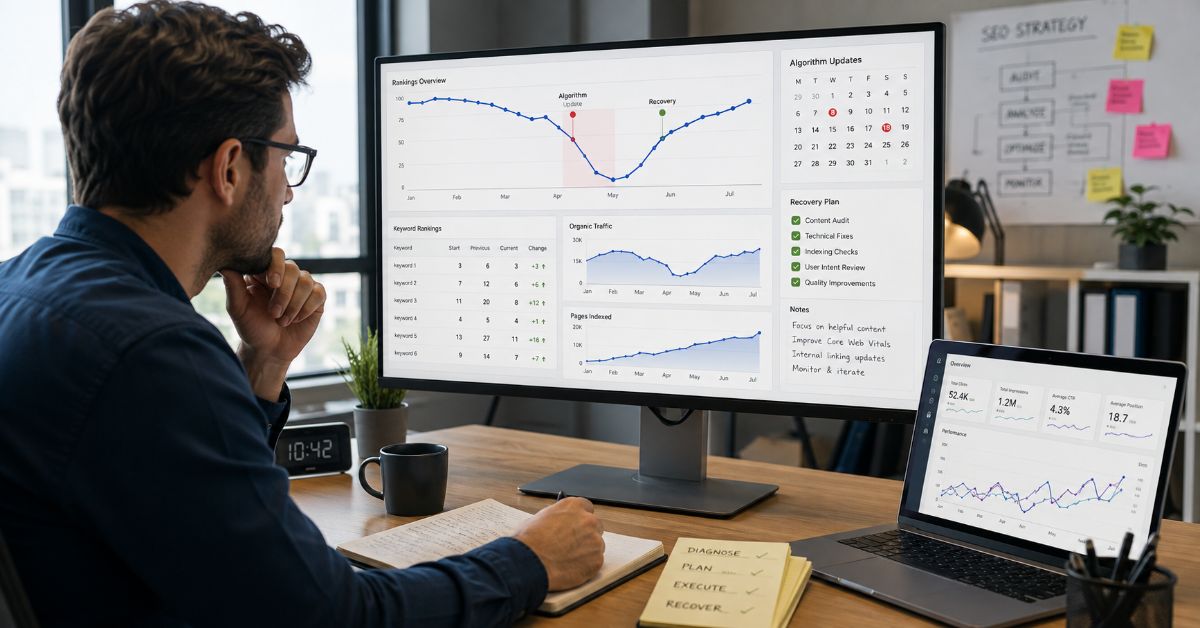
I approach the question of how to recover rankings after google update volatility as a diagnosis problem first and a content problem second. The fastest safe path is to confirm that a documented update overlaps the loss, wait until a core update finishes before judging the final impact, compare the right pre-update and post-update periods in Google Search Console, and isolate whether the decline is site-wide, template-wide, query-specific, technical, spam-related, or simply demand-driven. Once the cause is clear, recovery usually means improving the pages and site signals that genuinely underserve users, fixing crawl or indexing failures, removing policy violations when they exist, and strengthening originality, trust, usability, and intent satisfaction. It does not mean rewriting every page, deleting large sections because of a rumor, or chasing a single supposed ranking factor.
That distinction matters in 2026 because ranking volatility is no longer a once-or-twice-a-year event that can be explained by one headline. Google recorded core updates in March and May 2026, spam updates in March, June, and August 2026, plus a February Discover core update, while its documentation also says smaller core changes continue between publicly announced updates. As of August 29, 2026, the most recent listed ranking event is the August 2026 spam update, which ran from August 18 to August 21 and applied globally and across all languages. That makes disciplined attribution essential: a traffic decline that begins before the rollout, affects only one search type, coincides with a Search Console logging issue, or follows a migration may need a completely different fix. This guide uses Google documentation, current Search Status Dashboard records, Search Console guidance, and independent volatility analysis to turn that uncertainty into a repeatable recovery process.
What This Means for Site Owners, SEOs, and Publishers
A ranking drop after a Google update should trigger controlled investigation, not emergency editing. Google explicitly advises against drastic action for small position changes and recommends a deeper site-wide assessment when losses are large and sustained. For a publisher, this means protecting pages that still satisfy search intent while identifying weak clusters. For an in-house SEO, it means separating technical incidents from quality reassessment before asking content teams to rewrite. For an agency, it means giving clients an evidence trail that explains what changed, what did not change, and which actions are justified.
Start with timing. The Google Search Status Dashboard shows the August 2026 spam update beginning on August 18 and completing on August 21. Google says the update applies globally and to all languages. If a site lost visibility during that window, the overlap is relevant, but it is not proof that spam systems caused the loss. The same site could also have a technical outage, an indexing problem, a template deployment, a manual action, a demand decline, or a competitor gaining stronger intent fit. Use the AlgoUpdateTimes Update Impact Checker to put a suspected loss beside confirmed update dates, then continue the diagnosis rather than stopping at correlation.
The practical goal is to reduce false positives. Every unnecessary rewrite creates new variables, and every mass deletion removes information Google may still value. A recovery plan should therefore preserve what is working, prioritize pages with material loss, document each change, and measure results over meaningful comparison windows. That is also why this guide links to the Ranking Recovery hub and Algorithm Updates archive as supporting site resources rather than treating update news and recovery work as separate disciplines.
How Do You Confirm a Google Update Caused the Drop?
You confirm an update-related loss by matching the timing and shape of the decline to a documented rollout, then ruling out competing explanations with Search Console and technical evidence. Google recommends checking whether the core update has finished, noting its start and end dates, and waiting at least a full week after completion before making the main Search Console comparison. That waiting period matters because rankings can move during rollout and because a partial-window comparison can exaggerate or hide the real effect.
The 2026 release history shows how often those windows can overlap with ordinary site changes. A team that deploys a redesign on May 26, for example, would be changing the site in the middle of the May core update, which ran until June 2. Without a deployment log, analysts can easily attribute every movement to Google. The first table gives the confirmed ranking events most relevant to a 2026 recovery investigation.
| Google ranking event | Start | Completion / duration | Recovery relevance |
| March 2026 spam update | March 24, 2026 | About 19.5 hours | Check spam-policy compliance if losses align closely. |
| March 2026 core update | March 27, 2026 | April 8, 2026 | Use core-update diagnostic guidance after rollout completion. |
| May 2026 core update | May 21, 2026 | June 2, 2026 | Large cross-site visibility shifts were independently observed. |
| June 2026 spam update | June 24, 2026 | June 26, 2026 | Global, all-language spam update. |
| August 2026 spam update | August 18, 2026 | August 21, 2026 | Most recent listed ranking update as of August 29, 2026; global and all languages. |
The dates above come from Google’s ranking update history and individual incident records. Do not use third-party volatility alone to decide whether an official update was running. Volatility tools are valuable for context and market-wide pattern detection, but the Search Status Dashboard is the primary source for confirmed rollout timing.
Separate Update Timing From Search Console Data Anomalies
Before calling a chart drop a ranking loss, check whether the reporting system itself had a known issue. Google’s Search Console data anomalies page records a Discover logging error on August 13, 2026, and a separate Generative AI in Search logging error affecting impressions from August 13 through August 17, 2026. Those issues affected reporting, not ranking. This is exactly the kind of detail that can prevent a team from launching an unnecessary recovery project when the apparent dip is partly measurement noise.
Next, compare the loss period with the appropriate baseline. Google’s Performance report comparison guidance supports comparisons by date, page, device, country, query, and search appearance. For core updates, Google’s own recovery documentation recommends waiting a week after rollout completion and then comparing that week with a week before the update began. For broader trend diagnosis, longer weekly or monthly views can smooth out day-of-week effects and help expose seasonality.
Segment by Search Type, Page Group, and Query Intent
A real update impact rarely looks identical across every part of a site. Separate Web, Images, Video, News, and Discover where those reports are available. Then segment pages by template, content type, topic cluster, directory, author, commercial intent, freshness requirements, or another classification that matches how the site is built. Google’s traffic-drop documentation specifically recommends looking for whether the decline is site-wide, limited to a group of pages, or concentrated on one important URL.
Also inspect queries, not only URLs. A page can keep roughly the same impressions but lose clicks because its result became less attractive, a rich result changed, or a different result type now satisfies the query. Conversely, both impressions and clicks falling across many related queries is stronger evidence that visibility itself changed. This distinction prevents teams from treating a click-through-rate problem as a content-quality penalty or treating seasonal demand loss as an algorithmic demotion.
What Should You Diagnose Before Changing Content?
Diagnose technical eligibility, policy status, demand, SERP presentation, and the scope of the ranking loss before rewriting content. Google lists algorithmic changes, technical issues, security problems, spam issues, seasonality, changing interests, and site moves among the major causes of organic Search traffic drops. The point is not to find one universal cause. It is to build a short list of plausible causes and eliminate them with evidence.
Use this table as a first-pass triage map. The patterns are based on Google’s current traffic-drop debugging guidance.
| Observed pattern | Plausible cause | First check |
| Clicks fall, impressions stay relatively stable | Snippet or SERP attractiveness changed; richer competing results may be drawing clicks | Review titles, snippets, search appearance, and query-level CTR. |
| Clicks and impressions fall across many terms | Algorithmic reassessment, demand change, indexing issue, or broader site problem | Compare update dates, affected pages, indexing coverage, and Trends. |
| Sudden site-wide collapse | Server, robots, noindex, security, manual action, or severe deployment issue | Check uptime, Page Indexing, Crawl Stats, Security Issues, and Manual Actions. |
| Loss limited to a directory or template | Template quality, intent mismatch, technical rendering, canonical, or internal-link issue | Inspect representative URLs and compare unaffected templates. |
| Traffic drops while average positions barely move | Demand or CTR change rather than ranking loss | Compare impressions, CTR, search appearance, and Google Trends. |
| Drop follows URL migration or redesign | Re-crawling, redirects, canonicals, internal links, or migration errors | Audit redirects, canonicals, sitemaps, internal links, and indexed destinations. |
Check Technical Eligibility Before Quality
A page cannot recover through better prose if Google cannot reliably crawl, render, index, or serve it. Start with server availability, robots directives, noindex tags, canonicalization, redirect chains, JavaScript rendering, duplicate URL patterns, sitemap coverage, and internal links. Google describes technical issues as problems that can prevent crawling, indexing, or serving, and notes that they may be site-wide or page-specific.
Use representative URLs rather than testing only the homepage. Compare an affected page, an unaffected page on the same template, and a known strong page from another section. That three-way comparison helps reveal whether the issue is systemic or local. If a section lost ranking after a template change, inspect rendered content, canonical tags, structured data, internal navigation, pagination, and response status before asking writers to expand the text.
This is where the SEO Basics hub can support teams that need a refresher on crawlability and on-page fundamentals. Technical fixes should restore eligibility and clarity, but they should not be presented as a magic replacement for content quality or user value.
Check Manual Actions, Security, and Spam Exposure
A spam update requires a different recovery mindset from a broad core update. Google’s spam update guidance says sites that change after a spam update should review the spam policies and that improvements may take months while automated systems learn that the site complies. For link spam updates, Google adds an important caveat: removing the effect of spammy links can permanently remove the ranking benefit those links once provided, so the old benefit may not come back.
Check Search Console Manual Actions and Security Issues even when an update is in progress. Automated spam systems and manual actions are not the same thing, but both can suppress search visibility. Review the Google Search spam policies for scaled content abuse, scraped content, site reputation abuse, cloaking, misleading functionality, link spam, and other practices that may apply to the site. Do not assume that adding an author box or changing a few headings will solve a policy-level problem.
Check Seasonality and Demand Before Declaring a Penalty
Search demand can fall even when rankings hold. Google recommends using a 16-month view for context and comparing equivalent periods when seasonality is plausible. If impressions fell for the main queries but average positions stayed similar, open Google Trends and compare the topic or query family. A retailer can lose post-holiday demand, a travel site can move through seasonal cycles, and a news topic can simply stop being searched. None of those situations is fixed by “recovering” rankings that were never lost.
How Do You Recover Rankings After Google Update Losses?
To recover rankings after Google update losses, prioritize the pages and site patterns with the clearest evidence of reduced usefulness, trust, eligibility, or intent fit, then make durable improvements and measure them in controlled batches. Google’s core update guidance says to avoid quick fixes, focus on changes that make sense for users, and treat deletion as a last resort. That gives recovery work a clear operating principle: improve the experience and information architecture that caused the loss, not the superficial elements that happened to be present when the loss occurred.
1. Build a Loss Inventory by URL, Query, and Business Impact
Export Search Console data for the relevant comparison windows and create a recovery inventory. For each affected URL, record clicks, impressions, average position, major losing queries, search type, page template, topic cluster, conversion value, last substantive update, and whether the page has a close internal competitor. Rank the inventory by business impact and confidence of diagnosis, not by raw traffic loss alone. A page that lost 500 clicks but drives no qualified outcomes may deserve less attention than a page that lost 80 high-intent visits tied to revenue or leads.
Next, group losses. If twenty pages from one template dropped together, treat the template as a hypothesis. If only articles in one subject cluster fell, examine topical depth, freshness, expertise, and internal support. If rankings shifted from informational to transactional pages across the SERP, the issue may be intent alignment rather than “quality” in the abstract. The recovery plan becomes much more precise once each page belongs to a pattern.
2. Compare the Losing Page With the Results That Replaced It
A core update does not necessarily mean Google discovered something “wrong” with your page. Google explains that core updates broadly reassess which results are most helpful and reliable, and pages that move down can simply be overtaken by stronger alternatives. For every priority query, compare the current top results with the version of your page that lost visibility. Look for differences in intent match, specificity, first-hand evidence, freshness, task completion, source quality, media, navigation, and the amount of unique information.
Do not turn this into a copy exercise. If three competitors added the same definition, adding a fourth version of the same definition does not create distinct value. The better question is what the searcher can accomplish on the winning result that they cannot accomplish on yours. That might be a clearer decision framework, original data, a worked example, expert interpretation, a tool, a comparison table, better local context, or a more current answer.
3. Improve Originality, Completeness, and Intent Satisfaction
Google’s people-first content guidance asks whether content offers original information, reporting, research, or analysis; whether it gives a substantial and complete treatment of the topic; and whether it adds value beyond the obvious. Use those questions as editorial criteria, not as a checklist to mechanically satisfy. A recovery rewrite should add information that changes the reader’s understanding or ability to act.
For informational pages, remove padded introductions, answer the core question early, and then build depth in the order a reader needs it. For commercial pages, make comparisons explicit and support recommendations with verifiable criteria. For tools and utilities, improve the tool output and the explanation around it rather than surrounding a weak function with thousands of words. For news or update coverage, distinguish confirmed facts from industry interpretation and keep dates and rollout status current.
Preserve useful sections that still serve intent. Recovery is not a requirement to make every page longer. A shorter page with strong first-hand evidence and complete task coverage can outperform a longer page that repeats common knowledge. When pruning is justified, prefer merging duplicative pages, redirecting obsolete variants, or removing truly unsalvageable search-first content rather than deleting broad sections because they have low traffic.
4. Strengthen Trust, Sourcing, and Real Expertise
Trust improvements should make the page easier to verify. Identify the author or reviewer where readers reasonably care who produced the information, cite primary sources for claims, show dates when freshness matters, disclose methodology for tests or rankings, and make corrections visible when important facts change. For YMYL topics, the threshold for sourcing and expert review is naturally higher, but transparent sourcing improves ordinary SEO content too because readers can distinguish evidence from assertion.
Google’s people-first guidance encourages content that demonstrates first-hand expertise and gives visitors enough information to achieve their goal. That does not mean manufacturing personal anecdotes. It means including the evidence that actually exists: screenshots from the workflow, test conditions, original measurements, named experts, real examples, or a clear explanation of how conclusions were reached.
5. Improve Page Experience Without Treating One Metric as the Algorithm
Google says its core ranking systems look to reward a good overall page experience and advises site owners not to focus on only one or two aspects. The page experience guidance highlights Core Web Vitals, secure delivery, mobile usability, restrained advertising, avoidance of intrusive interstitials, and a layout where visitors can distinguish the main content. Those are useful recovery checks, but a passing speed score does not compensate for thin or untrustworthy content.
Audit the actual page a searcher sees on a real device. Check whether the answer is buried behind ads, whether sticky elements obscure content, whether a table becomes unreadable on mobile, whether the primary interaction is delayed, and whether navigation makes the next step obvious. When a performance optimization also improves usability, it is worth prioritizing. When a team is shaving milliseconds from an already usable page while ignoring a confusing information architecture, the effort is probably misallocated.
6. Rebuild Internal Support Around Priority Pages
Internal links help users and crawlers understand relationships between pages, and they can expose whether a site architecture actually supports the pages the business considers important. After an update, inspect orphaned or weakly linked priority pages, competing articles that target the same intent, stale navigation modules, and category pages that fail to connect related material. Use descriptive anchors that explain the destination rather than generic calls to action.
This pillar guide itself follows that principle by linking readers to the Ranking Recovery hub when they need recovery-focused material and to the Algorithm Updates archive when they need update chronology. The same pattern should exist across the site: explanatory pages should connect to diagnostic tools, update reports should connect to recovery guidance, and foundational SEO pages should support the technical steps that appear in higher-level articles.
7. Handle Spam-Update Recovery as Compliance Work
If the timing aligns with a spam update, start with policy compliance rather than a generic content refresh. Scaled pages built primarily to capture search traffic, lightly rewritten scraped material, manipulative link patterns, cloaking, misleading functionality, and third-party sections designed mainly to exploit a host site’s ranking signals require structural correction. A few rewritten paragraphs do not change the production model that created the problem.
Document what was removed or changed, why it violated or risked violating policy, and how the new process prevents recurrence. For large sites, this may require changes to editorial approvals, programmatic page generation, partner content rules, link acquisition, or indexation controls. Google states that automated systems may take months to learn that a site now complies, so the recovery plan should include patience and continued compliance rather than repeated cosmetic changes.
What Does Google Mean by Helpful Content in 2026?
In 2026, Google’s public guidance still centers on valuable, unique, people-first content, even as Search expands through AI Overviews, AI Mode, Discover, and other result formats. That continuity matters because teams sometimes react to a ranking loss by inventing a separate “AI optimization” layer instead of fixing the underlying usefulness of the page.
John Mueller of Google Search Relations wrote in May 2025: “Focus on your visitors and provide them with unique, satisfying content.” The Google Search Central guidance on AI search that contains that statement also says the same foundations apply across classic and AI search experiences, including technical accessibility, structured data accuracy, page experience, and high-quality multimedia where it helps the user. Google reinforced the direction in May 2026 with new generative AI optimization guidance emphasizing valuable, unique, non-commodity content and the continued relevance of established SEO best practices.
For recovery, the practical interpretation is straightforward. A page should make sense and remain useful even if a user arrives from an AI-generated answer with more context than a traditional blue-link searcher had. That favors precise claims, clear attribution, original evidence, well-structured answers, and pages that let the visitor continue the task rather than merely restating what the SERP already summarized. It also argues against content written mainly to manipulate how an AI summary describes the page.
What Can Recent 2026 Update Data Teach Us?
Independent tracking can show the shape and scale of SERP movement, but it should be used as evidence of change, not as proof of a specific hidden ranking factor. SISTRIX’s analysis of the May 2026 core update is useful because it combines a clearly documented Google rollout window with large-scale visibility observations and explicitly shows that different sectors and domains moved in different directions.
The SISTRIX May 2026 core update analysis reports that its Google Update Radar tracks movement across one million SERPs each day. In its May 2026 analysis, SISTRIX compared data across the update window and published large winner-and-loser lists for the US and UK. It also reported little impact across a sample of 451 UK ecommerce domains while 77 UK news media domains showed a strong net negative result. Those observations do not mean ecommerce was “safe” or news was universally “hit”; they show why recovery work must be segmented by market, vertical, intent, and page type.
| Observed evidence | Verified detail | Recovery implication |
| Rollout duration | May 21 to June 2, 2026 | Do not evaluate a partial rollout as the final outcome. |
| Tracker scale | SISTRIX Update Radar monitors 1 million SERPs daily | Use market-level volatility as context, not as a site diagnosis by itself. |
| UK ecommerce sample | 451 domains showed very little aggregate impact in the cited analysis | A sector can appear stable overall while individual sites still move sharply. |
| UK news sample | 77 news media domains showed a strong net negative result | Segment recovery analysis by vertical and content model. |
| Domain-level movement | Large winners and losers appeared in both US and UK data | Competitor replacement patterns can reveal intent and quality gaps. |
Aleyda Solis, quoted in the SISTRIX analysis, described part of the movement as “an intent-destination reset.” That framing is useful because it shifts the recovery question away from “Which factor was punished?” and toward “Which destination now best satisfies the query?” When Google has not confirmed a particular signal change, treat such interpretations as analyst hypotheses, then test them against your own lost queries and the pages that replaced you.
Advanced Web Ranking’s June 2026 recovery analysis makes a related methodological point: do not over-fit to a single number or one speculative explanation. Its core update recovery framework argues for diagnosing eligibility, comprehension, content quality, trust, experience, anti-manipulation, and source or entity signals as interacting layers. Some of the article’s deeper architectural interpretation is based on patents and other indirect evidence, so it should not be mistaken for Google confirmation. The useful operational lesson is simpler: recovery usually fails when teams optimize one surface while ignoring the rest of the system.
How Should Agencies and In-House Teams Run the Recovery Process?
The best recovery workflow separates diagnosis, remediation, and measurement so stakeholders can tell which changes were made for which reason. That structure is especially important when revenue is falling and multiple teams want to act at once. A single shared recovery log can prevent engineering, editorial, PR, and SEO teams from creating overlapping changes that make the result impossible to interpret.
For Site Owners and Small Teams
Keep the first pass narrow. Confirm the update window, check Search Console for scope, rule out indexing and manual-action problems, then select the ten to twenty pages with the greatest business impact. Compare those pages with current winners, improve the clearest deficiencies, and track changes by date. Avoid turning the entire website into a simultaneous experiment unless the diagnosis reveals a genuine site-wide policy or technical problem.
For In-House SEO Teams
Create a cross-functional incident review. Bring Search Console data, deployment history, content release dates, analytics, crawl data, and revenue metrics into the same timeline. Engineering should verify availability, rendering, canonicals, redirects, and indexation. Editorial should evaluate intent, originality, depth, and source quality. Product or UX teams should review experience issues on affected templates. The SEO lead should own the hypothesis register so every proposed fix has supporting evidence and an expected measurement signal.
For Agencies
Separate what is confirmed from what is inferred in every client update. Confirmed items include Google rollout dates, Search Console losses, technical errors, manual actions, and observed competitor changes. Inferences include why a competitor replaced the client, which quality dimension likely mattered, and how long a particular fix may take to influence rankings. This distinction builds trust and prevents clients from treating industry speculation as an official Google explanation.
Agencies should also avoid selling a universal “core update recovery package” that applies the same checklist to every site. A spam-policy problem, a migration error, a local-intent shift, and a publisher-wide quality reassessment require different skills and different evidence. The deliverable should be a diagnosis and prioritized remediation plan, not a ritual sequence of title changes, content expansion, internal links, and schema additions.
What Should You Avoid After a Google Update?
Avoid radical, high-volume changes that are not tied to a verified problem. Google’s core update documentation specifically warns against quick-fix changes based on rumors and recommends meaningful, sustainable improvements instead. That warning is easy to ignore when a dashboard is falling, but panic edits can destroy strong sections, reset useful page signals, create redirect mistakes, and make it harder to learn what actually caused the loss.
- Do not rewrite every page just because a core update rolled out. Prioritize pages with material, sustained loss and a clear improvement opportunity.
- Do not mass-delete low-traffic content without evaluating whether it serves users, supports topical navigation, earns links, or can be consolidated. Google describes deletion as a last resort.
- Do not manufacture first-person experience, fake experts, invented statistics, or unsupported claims to imitate E-E-A-T. Trust comes from evidence that can be checked.
- Do not treat Core Web Vitals, schema, word count, or keyword density as a single recovery lever. They can matter within a broader experience, eligibility, or relevance problem, but none explains every core-update loss.
- Do not assume every ranking change during a spam update means the site violated policy. Confirm Manual Actions, audit policies, and examine the affected page patterns before making that conclusion.
- Do not use a third-party volatility chart as the only evidence of an update. Use Google’s confirmed rollout history for timing and third-party tools for context.
- Do not change URLs casually during recovery. URL changes introduce crawling, redirect, canonical, and internal-link variables at the moment you need a stable measurement baseline.
How Long Does Ranking Recovery Take?
There is no guaranteed ranking-recovery timeline. Google says some improvements can affect Search within a few days, while other changes may take several months as systems learn and confirm that a site is producing helpful, reliable, people-first content over time. Google also clarified in December 2025 that sites do not necessarily need to wait for the next major core update because smaller core updates continue without public announcements and can reflect improvements.
Spam-related recovery can be slower. Google says a site that corrects spam-policy violations may improve if automated systems learn over a period of months that it complies. For link spam, the previous benefit from spammy links may be gone permanently once the system neutralizes it. That is not a failed recovery; it means the new baseline must be earned through legitimate signals rather than restored through the same links.
For planning purposes, use an operational timeline rather than a promise. In the first two weeks after a rollout, stabilize measurement, confirm scope, and fix urgent technical or policy issues. Over the next several weeks, ship high-confidence improvements to priority clusters and monitor crawling, indexing, query visibility, and conversions. Over subsequent months, evaluate whether site-wide trust, content quality, and demand signals are improving. These phases are a project-management framework, not a Google guarantee, and the right duration depends on site size, crawl frequency, severity of the problem, and how fundamental the remediation is.
Ranking Recovery Checklist
A useful ranking recovery checklist should keep the team focused on evidence and sequence. Work through the items below in order, and stop to investigate whenever the evidence points away from an algorithm update.
- Record the exact date and time range when traffic or rankings changed.
- Check the Google Search Status Dashboard for a confirmed ranking update or system incident.
- For a core update, wait until rollout completion and at least one full week before the main before-and-after comparison.
- Check Search Console data anomalies so reporting errors are not mistaken for ranking losses.
- Compare clicks, impressions, CTR, and average position across equivalent periods.
- Segment Web, Images, Video, News, Discover, device, country, query, and search appearance where relevant.
- Identify whether the loss is site-wide, directory-wide, template-specific, topic-specific, or isolated to a few URLs.
- Check Page Indexing, Crawl Stats, URL Inspection, server logs, robots, noindex, canonicals, redirects, rendering, and sitemap coverage.
- Check Manual Actions and Security Issues.
- If a spam update overlaps the loss, audit the current spam policies and the site production model.
- Use Google Trends to rule out seasonality and demand change.
- Compare priority losing pages with current ranking replacements for intent, originality, evidence, trust, usability, and task completion.
- Improve the highest-confidence issues in controlled batches and log every material change.
- Strengthen internal linking to priority pages and consolidate genuine duplication or cannibalization.
- Re-measure after enough time for recrawling and ranking systems to process changes, without promising a fixed recovery date.
Frequently Asked Questions
Can a site recover before the next Google core update?
Yes. Google says you do not necessarily have to wait for the next major core update because smaller core updates happen continually and can reflect improvements. Some changes can show effects in days, while broader site-level reassessment can take months.
Should I delete pages that lost rankings after an update?
Not automatically. Google describes deletion as a last resort. First determine whether the page can be improved, merged, redirected, or repositioned to better satisfy users; remove content when it is genuinely unsalvageable or part of a search-first production pattern.
Does a ranking drop during a spam update prove my site violated spam policies?
No. Timing is correlation, not proof. Review Google’s spam policies, Manual Actions, affected page patterns, technical changes, and demand before concluding that a spam system caused the loss.
How long should I wait before analyzing a core update?
Google recommends waiting until the rollout is complete and then at least one full week before the main Search Console analysis. Compare that post-update week with a week before the rollout began, then investigate pages and queries that changed materially.
Is AI search optimization separate from ranking recovery?
Not at the foundation. Google’s 2025 and 2026 guidance says established SEO best practices, unique and valuable content, technical accessibility, and a strong page experience remain relevant to generative AI features in Search. Recovery work that improves those fundamentals can support both classic and AI search visibility.
What Happens Next?
Ranking recovery is best treated as a durable improvement program, not a one-off response to a named update. Google’s systems keep changing, competitors keep publishing, user expectations move, and demand shifts. The sites that handle volatility well are the ones that can quickly distinguish a real algorithmic reassessment from a technical incident, reporting anomaly, seasonal decline, or SERP change, then improve the right layer without destabilizing everything else.
After the immediate recovery work, keep the same instrumentation in place. Maintain a deployment log, annotate major editorial changes, watch Search Console by page group and search type, monitor the Google Search Status Dashboard for confirmed updates, and review the AlgoUpdateTimes Update Impact Checker after meaningful volatility. The objective is not to become immune to updates. No site can guarantee that. The objective is to make every future drop easier to diagnose and every improvement more likely to create lasting value for users.
Sources
- Google Search Status Dashboard – Ranking history – Confirmed 2026 core and spam update dates and durations.
- Google Search Status Dashboard – August 2026 spam update – Confirmed August 18 to August 21 rollout, global and all languages.
- Google Search Central – Core updates and your website – Core update diagnosis, waiting period, small vs large drop examples, remediation and recovery timing.
- Google Search Central – Spam updates and your site – Spam update recovery expectations and link-spam caveat.
- Google Search Central – Debugging drops in Google Search traffic – Causes of traffic loss and Search Console diagnostic workflow.
- Google Search Central – Creating helpful, reliable, people-first content – Content-quality, originality, expertise, and people-first self-assessment criteria.
- Google Search Central – Spam policies for Google web search – Current spam policy definitions and compliance considerations.
- Google Search Central – Understanding page experience – Overall page-experience considerations including Core Web Vitals, mobile usability, ads, and interstitials.
- Google Search Console Help – Advanced filtering and comparison – Comparison and segmentation methods for Performance reporting.
- Google Search Console Help – Data anomalies – August 2026 reporting anomalies used to distinguish logging issues from ranking changes.
- Google Search Central Blog – Top ways to ensure content performs well in AI experiences – John Mueller guidance on unique, satisfying content and technical foundations for AI and classic Search.
- Google Search Central Blog – A new resource for optimizing for generative AI in Google Search – 2026 guidance emphasizing unique, non-commodity content and established SEO best practices.
- SISTRIX – May 2026 Core Update visibility analysis – Independent SERP movement data, sector observations, and Aleyda Solis commentary.
- Advanced Web Ranking – Diagnosing, auditing, and recovering from core updates – Independent recovery framework and caution against over-fitting to single signals.