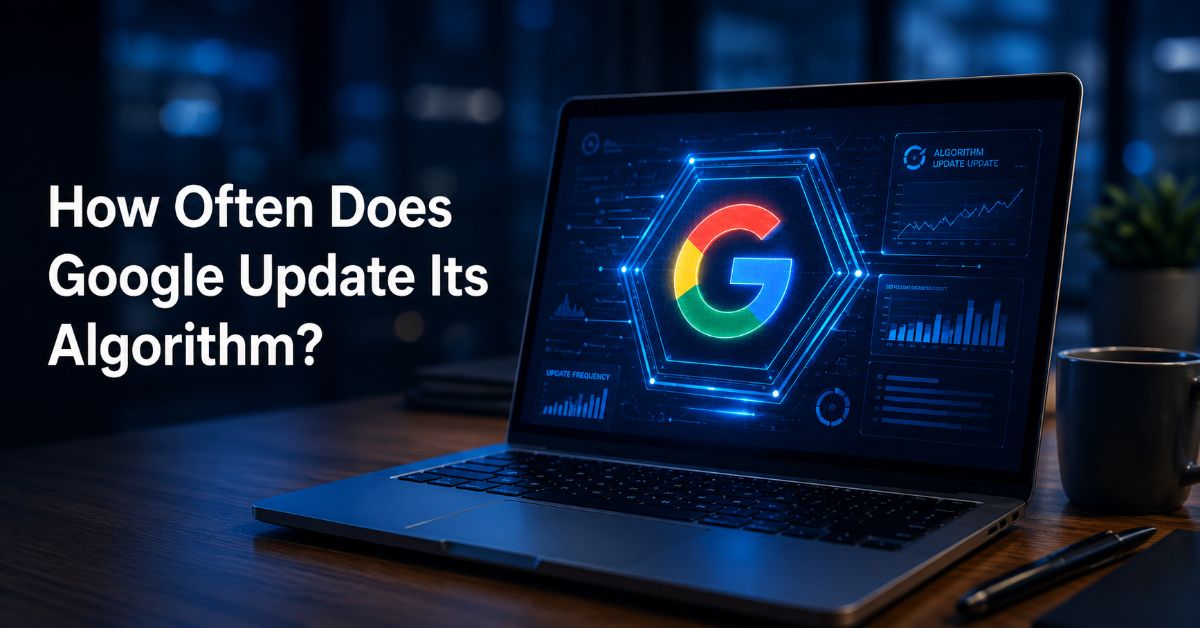
How often does google update its algorithm? Google changes Search thousands of times each year, but only a small fraction become named or publicly announced ranking updates. Broad core updates usually arrive several times a year, while spam systems operate continuously and receive occasional announced upgrades. In 2026 through August 29, Google’s Search Status Dashboard lists six announced ranking-related rollouts: a Discover core update, two broad core updates, and three spam updates. I treat that distinction as the starting point because it stops a common SEO mistake: assuming every visible ranking change must correspond to a named update. Google Search is a collection of ranking, spam, retrieval, interpretation, and presentation systems that are improved at different speeds. Danny Sullivan, then Google’s Public Liaison for Search, summarized the scale plainly in Google’s own explanation: “Google Search is updated thousands of times a year.” The official Google explanation of how Search is updated also describes extensive evaluation and testing before changes launch. That means the practical answer is not a single calendar interval such as weekly or monthly. The algorithm changes continually, while the biggest broad changes are announced on a much slower cadence.
I also would not use the public update calendar as a complete log of everything that can move rankings. Google says it announces updates it considers notable, not every incremental adjustment. The Google Search Status Dashboard history is therefore best read as a record of major events that website owners may need to interpret, not as a changelog for the entire search engine. That matters in 2026 because ranking volatility can also come from ongoing systems, spam detection, crawling and indexing changes, SERP feature shifts, AI-driven search experiences, competitors, seasonality, and changes on your own site. A disciplined SEO response starts by separating an announced rollout from ordinary background change. This guide explains the different update layers, the current 2026 schedule, how long rollouts last, what third-party volatility trackers can and cannot prove, and the point at which site owners should actually investigate or change something.
How often does Google update its algorithm?
Google updates its search algorithms and systems continuously, makes thousands of changes over a year, and publicly announces only the subset that is significant enough to be useful for publishers and site owners. The cleanest way to understand frequency is to separate everyday improvements from notable ranking-system updates and from the slower cadence of broad core updates.
Google’s Q&A on Search updates says Search is updated thousands of times per year and explains that many changes are relatively small and incremental. In that same guidance, Google said it shared 10 notable updates in 2021 and another 10 in 2022. The ratio is the important point: the public hears about a handful of major events while the underlying search engine changes far more often.
Core updates sit in the middle of this hierarchy. Google’s current core update documentation says significant broad changes happen several times a year. Spam protection has a different operating model. Google’s spam update documentation says automated spam-detection systems are constantly operating, while Google occasionally announces notable improvements to those systems as spam updates.
What actually counts as a Google algorithm update?
An algorithm update is any meaningful change to the automated systems that select, understand, evaluate, rank, filter, or present search results, but Google does not use the word “update” as a label for every visible movement in rankings. The term can refer to a change in a ranking system, an improvement to a spam system, a broad core update, or a specialized change such as a Discover update.
Google has tried to make the language more precise. Its guide to ranking systems and updates distinguishes a ranking system from an update to that system. A system can keep operating after launch, and Google can improve it without creating a permanently separate “algorithm” with its own public name. That distinction is useful because older SEO conversations often treated Panda, Penguin, helpful content, reviews, page experience, and other labels as if Search were a stack of independent filters switched on and off. Modern Search is better understood as many interacting systems that can be refined over time.
The public announcement threshold is also editorial rather than mechanical. Google says it shares updates when it believes they may be notable enough that guidance could help site owners interpret changes. As a result, an unannounced ranking shift is not evidence that Google is hiding a “secret core update.” It may be a smaller system adjustment, a changed competitor set, a query-level shift, recrawling, refreshed content, a SERP-layout change, or ordinary statistical noise.
For analysis, I use three buckets: continuous operation, routine improvements, and announced notable rollouts. Continuous operation includes systems such as spam detection that evaluate pages all the time. Routine improvements include the many incremental changes Google tests and launches across Search. Announced rollouts include core, spam, Discover, and other updates recorded on the public dashboard. Mixing these buckets produces false certainty about cause and effect.
The three update layers SEOs should track
The table below turns Google’s public descriptions into an operational model. The frequency column is deliberately qualitative because Google does not publish a fixed timetable for most changes.
| Layer | Typical frequency | Public announcement | SEO interpretation |
| Continuous systems | Always operating | Usually no | Expect ongoing re-evaluation as Google recrawls and reprocesses signals. |
| Routine Search improvements | Thousands of changes per year in aggregate | Usually no | Do not map every daily ranking change to a named update. |
| Broad core updates | Several times a year | Yes | Use dashboard dates, wait for rollout completion, then analyze sustained changes. |
| Notable spam updates | Occasional, while spam systems run continuously | Yes | Review spam policies if losses line up with a confirmed spam update. |
| Specialized updates | Irregular | Sometimes | Check scope carefully, such as Discover-specific changes, before generalizing to web ranking. |
How often does Google release broad core updates?
Google releases broad core updates several times a year, but there is no guaranteed monthly or quarterly schedule. In some years the intervals are relatively even, while in others two core updates can land close together or a long gap can open between them.
The wording in Google’s core-update documentation is intentionally flexible. A core update is a broad change intended to improve how Search surfaces helpful and reliable results across many topics and sites. It is not a penalty campaign aimed at a list of domains. Because the work depends on testing and engineering readiness, a rigid publishing calendar would create the wrong expectation that an update must ship because a date has arrived.
Recent history demonstrates the variability. The 2024 dashboard records core updates beginning in March, August, November, and December. In 2025 it records core updates beginning in March, June, and December. In 2026 through August 29, it records core updates beginning March 27 and May 21. The pattern supports Google’s “several times a year” description, but it does not support a rule such as “one core update every three months.”
This is also why forecasts based purely on the previous gap are weak. If six months passed between two updates last year, that does not make another six-month interval more likely this year. For operational planning, assume a core update can arrive at any point, maintain clean baselines in Search Console and analytics, and use the official dashboard to confirm the event when it happens.
How does the recent history compare year by year?
Recent public history reinforces the gap between announced events and the much larger number of changes happening inside Search. The official ranking history records named updates that Google considered relevant to website owners, but it is not intended to enumerate every improvement made to ranking and retrieval systems.
In 2022, Google’s later Q&A said it shared 10 notable updates. The dashboard record for 2023 shows a mix of core, spam, reviews, helpful-content, and product-review updates. In 2024, the public ranking history included four broad core updates plus spam updates, with the March core rollout lasting 45 days and the November core update lasting more than 23 days. Those long rollouts show why annual counts alone do not describe the operational impact.
The pace looked different in 2025. The dashboard lists broad core updates beginning in March, June, and December, along with an August spam update. Fewer named events did not mean Search changed less often overall. It only meant fewer changes crossed Google’s public-announcement threshold. That distinction matters when teams compare year-over-year volatility and conclude that Google has become more or less active based on announcement counts alone.
For planning, use historical counts as context rather than prediction. A year with three core updates does not establish a new annual quota, and a quiet month does not imply ranking systems are static. The durable takeaway is that notable rollouts are intermittent, ordinary changes are continuous, and the official history becomes most useful after an event has been announced and dated.
What does the 2026 Google update schedule show?
The 2026 schedule shows that notable updates can arrive in clusters and can target different parts of Search. Through August 29, the official ranking history lists six announced rollouts, with five of them starting between late March and late August after the February Discover update.
The year began with a February 5 Discover core update. Google’s official Discover announcement said the rollout initially applied to English-language users in the United States and was designed, among other things, to show more locally relevant content, reduce sensational or clickbait content, and surface more in-depth, original, timely material from sites with topic expertise. That is a good example of why scope matters: a Discover update should not automatically be blamed for a web-search ranking decline.
March then brought two separate ranking events. The March spam update started March 24 and completed in under a day, while the March core update began March 27 and took a little over 12 days. May brought the second core update of the year. June and August each brought another spam update. This cadence illustrates why monitoring must identify the update type rather than simply tagging a chart with “Google update.”
The official dashboard provides start dates and rollout duration. The durations below are taken from Google’s ranking history as displayed on August 29, 2026.
| 2026 update | Start date | Recorded duration | Scope/type |
| February 2026 Discover update | February 5, 2026 | 21 days, 17 hours | Discover |
| March 2026 spam update | March 24, 2026 | 19 hours, 30 minutes | Spam |
| March 2026 core update | March 27, 2026 | 12 days, 4 hours | Broad core |
| May 2026 core update | May 21, 2026 | 11 days, 21 hours | Broad core |
| June 2026 spam update | June 24, 2026 | 2 days, 1 hour | Spam |
| August 2026 spam update | August 18, 2026 | 2 days, 16 hours | Spam |
Why does Google not publish a fixed update calendar?
Google does not publish a fixed algorithm-update calendar because Search improvements are developed, evaluated, and launched according to readiness rather than a marketing timetable. A release date is the end of a testing process, not the first step in one.
Google’s explanation of Search updates says proposed changes go through evaluation, including quality-rater feedback, live experiments, and analysis before launch. That process helps explain why the external cadence looks uneven. A change that performs well can launch; one that does not meet the required quality bar can be revised or abandoned. There is no reason those outcomes should line up neatly with the end of a month or quarter.
A second reason is that there is no single Google algorithm. Search uses many systems and signals. Different engineering teams can improve different systems at different times. Google’s 2023 update Q&A also says it tries to separate notable updates so site owners can better identify which system may be involved. That is a communication goal, not a promise that rollouts will never overlap or occur close together.
For publishers, the absence of a calendar is a reason to improve observability rather than prediction. Keep reliable deployment logs, content-change annotations, migration records, and Search Console exports. When a ranking event occurs, those records let you compare Google’s timeline with your own. Predicting the next update date is much less valuable than knowing what changed on your site when the next update actually arrives.
How long does a Google algorithm update take to roll out?
A named Google update can finish in less than a day or continue for several weeks, depending on the update. Broad core rollouts are commonly measured in roughly one to several weeks, while recent spam updates have sometimes completed much faster.
Google often gives a forward-looking estimate when a rollout begins, but the final duration is what matters for diagnosis. The May 2026 core update was announced May 21 with an expectation of up to two weeks. The Search Engine Land completion report recorded Google’s confirmation on June 2, and the official dashboard shows a duration of 11 days and 21 hours. The March 2026 core update similarly ran a little more than 12 days.
Spam rollouts can have a very different shape. The March 2026 spam update completed in 19 hours and 30 minutes. The June spam update took just over two days. The August spam update took 2 days and 16 hours, and Search Engine Land’s August report noted that it applied globally and to all languages. The practical implication is that “Google updates take two weeks” is not a safe general rule.
Rollout duration also affects analysis. A ranking graph can rise, fall, reverse, and settle while a broad update is still propagating. Comparing the first morning of a rollout with the prior day can produce a dramatic story that disappears by completion. Google’s core-update guidance recommends confirming that the rollout is finished and waiting at least a full week afterward before making a detailed Search Console comparison. That advice is more defensible than reacting to hourly screenshots.
What do third-party volatility trackers tell you between updates?
Third-party volatility trackers can show that search results are moving unusually quickly, but they cannot by themselves prove that Google launched a particular algorithm update. They measure observed SERP change, not Google’s internal release log.
The Semrush Sensor methodology describes daily monitoring of ranking changes and provides industry-level volatility scores. This is useful because broad turbulence can help distinguish a site-specific problem from a wider movement. But the signal is still observational. A high score can coincide with an announced update, an unannounced change, a feature-layout shift, or several things happening at once.
SISTRIX offers a complementary view through its Update Radar and Visibility Index datasets. During the March 2026 core update analysis, SISTRIX reported generally high background movement but no major increase in its US and UK radar during much of the rollout. It described the March update as relatively modest compared with background change, even though some individual domains moved sharply. That is an important warning against assuming every core update creates a huge market-wide spike.
The SISTRIX May 2026 analysis showed a different pattern. Its UK radar reached very high values during the May rollout, and the report identified large visibility changes across individual domains. The contrast between March and May illustrates why update names are not severity scores. Two events can both be called core updates and still have very different observable footprints by country, sector, query set, and domain.
For a working SEO team, use trackers as corroboration. Start with the official dashboard for confirmed events, then use independent datasets to judge breadth and timing, and finally examine your own first-party Search Console and analytics data. If only your site falls while broad trackers are calm and no update is announced, investigate technical, content, demand, or competitive causes before blaming the algorithm.
Why can rankings change when no Google update is announced?
Rankings can change without an announced update because the search ecosystem itself is dynamic and because most Google improvements are not publicly named. An announcement is only one possible explanation for volatility.
The index changes as Google crawls new pages, reprocesses existing pages, discovers redirects, sees updated internal links, and encounters changed structured data or canonical signals. Competitors publish, remove, merge, or improve content. Search demand shifts. News cycles alter query interpretation. SERP features can appear or disappear. A page can move even if Google has not launched any major new ranking system that day.
Continuous systems are another source of movement. Google says its automated spam-detection systems are constantly operating. If those systems re-evaluate a site or discount manipulative signals, the result can look like an “update hit” even when there is no fresh spam-update announcement. Conversely, the absence of a spam announcement does not mean spam systems are idle.
Modern search presentation adds another layer. A page can keep a similar organic ranking while clicks change because the result page around it changed. AI experiences, rich results, video modules, local packs, shopping units, discussion modules, and other features change the amount of attention available to a traditional result. That is why impressions, average position, clicks, click-through rate, and query mix should be analyzed separately rather than collapsed into one traffic chart.
Finally, your own releases can mimic algorithmic volatility. Template changes, JavaScript failures, navigation revisions, migrations, robots directives, noindex mistakes, canonical changes, server instability, content pruning, and sitewide title rewrites can create sudden search losses. A strong incident process compares the first affected date with both Google’s dashboard and the site’s deployment log.
What this means for site owners, SEOs, and publishers
The practical response to frequent Google changes is not to chase every fluctuation. It is to build a site and an operating process that can absorb continuous re-evaluation while making major anomalies easy to diagnose.
For site owners, the priority is resilience. Keep technically important pages crawlable, indexable, internally connected, and stable. Maintain content that genuinely satisfies its audience rather than being engineered around a temporary pattern. When a confirmed core update causes a sustained decline, Google says broad core changes do not target specific pages as penalties. The task is to assess whether competing results now provide stronger usefulness, originality, trust, or satisfaction for the relevant searches.
For in-house SEO teams, update readiness is a data problem as much as a content problem. Annotate significant releases, preserve Search Console exports for major dates, segment branded and non-branded queries, and maintain page-type cohorts. A six-percent organic decline can mean very different things if it is concentrated in one template, one country, one device class, or one information category. Update analysis becomes much faster when those segments already exist before the incident.
For agencies, the main risk is premature storytelling. Clients naturally want a cause on the first day a dashboard turns red. A responsible answer may be that a rollout is still in progress or that no official update has been confirmed. Explain the evidence hierarchy: official Google status, independent SERP volatility, client Search Console data, technical checks, competitive changes, and only then a working diagnosis. This makes the recommendation more credible than assigning every dip to whichever update name is trending on social media.
For publishers, separate ranking from distribution. Discover, Top Stories, web search, Google News, image search, and AI-oriented surfaces can behave differently. The February 2026 Discover update is a clear reminder that Google can make broad changes to a discovery surface without implying the same ranking change occurred in standard web results. Report by surface whenever the data allows it.
How can you tell whether a traffic drop was caused by a Google update?
You cannot prove causation from timing alone, but you can build a strong diagnosis by matching dates, scope, query patterns, page groups, and external volatility while ruling out site-side causes.
Start with the Google Search Status Dashboard guidance. Google says the dashboard lists ranking updates relevant to website owners and also reports widespread crawling, indexing, and serving incidents. If an event appears there, record its start and completion dates. If nothing appears, keep an open mind rather than assuming an unconfirmed core update.
Next, define the first date the change becomes statistically meaningful. Daily data is noisy, especially on smaller sites. Compare same weekdays where appropriate and inspect a seven-day view. For a core update, Google recommends waiting until the update has completed and then waiting at least another week before doing a detailed before-and-after analysis. This reduces the chance that you treat rollout turbulence as the final outcome.
Then segment the loss. Is it one country or worldwide? Mobile or desktop? Informational queries or commercial pages? A specific directory, author, topic, or content type? Branded or non-branded demand? Pages that lost position or pages that kept position but lost clicks? These distinctions often eliminate weak explanations quickly.
Run technical checks in parallel. Verify indexing, robots controls, canonicalization, server status, rendering, internal linking, sitemap behavior, and recent releases. If a technical defect started on the same date as a core update, the public update does not make the defect irrelevant. Correlation with Google’s rollout should never override direct evidence from your own crawl and logs.
Finally, compare independent trackers and competitors. If several major competitors in the same query set moved at the same time and broader trackers show turbulence, a systemic change becomes more plausible. If competitors are stable and your site alone changed immediately after a deployment, prioritize the site-side explanation. The goal is not to name an update quickly. The goal is to reach the most testable explanation.
Should you change your site while a core update is still rolling out?
Usually, do not make sweeping content or architecture changes solely because early core-update data looks bad. Fix clear technical failures immediately, but wait for the rollout to finish before interpreting broad ranking effects.
This does not mean freezing a business for two weeks. If checkout is broken, robots.txt blocks important sections, pages return errors, or a deployment removed canonicals, fix the problem. Those are independent defects with direct evidence. What should wait is the speculative response: rewriting hundreds of pages, deleting large content sections, changing templates, or reversing a content strategy because rankings moved for two days during an active rollout.
Google’s current core guidance gives a useful analytical buffer. Confirm completion on the dashboard, then wait at least a full week before comparing the right periods in Search Console. For larger changes, Google also cautions against quick-fix thinking and recommends assessing content in a meaningful way. That approach is compatible with how core systems work: broad ranking recalibration can change which documents are considered most useful without identifying a single broken field that can be patched overnight.
A controlled workflow is faster in the long run. Preserve the pre-update baseline, mark rollout dates, watch the most important page cohorts, and note any genuine defects separately. Once the rollout settles, compare stable periods and prioritize changes that would improve the site even if the update had never happened. That standard protects teams from update-driven busywork.
How has frequent algorithm change altered modern SEO work?
Frequent algorithm change has pushed SEO away from update-chasing and toward continuous quality control, technical reliability, strong first-party measurement, and clearer evidence standards.
A decade ago, an SEO playbook could become tightly associated with a named update. Today, Google’s own language emphasizes systems that are continuously operating and improved over time. That does not make updates irrelevant. Core and spam rollouts can still produce large commercial effects. It does mean that the durable unit of work is not “optimize for the March update.” It is improve the site’s ability to satisfy users, expose its content clearly to crawling and indexing systems, and demonstrate value in the query spaces it serves.
The rise of AI-driven search experiences strengthens this need for separation. Changes in clicks can now occur because ranking changed, because result composition changed, or because the user completed more of the task inside the search experience. A position-only report is therefore increasingly incomplete. Search teams need query demand, impressions, positions, clicks, conversions, page cohorts, SERP-feature context, and where available separate performance reporting for newer search surfaces.
Update journalism also needs a higher standard. A screenshot from a volatility tool is evidence of movement, not proof of causality. A tweet describing a traffic fall is a case report, not a representative sample. The official dashboard confirms a rollout, while independent tools help characterize its external footprint. The strongest analysis states which level of evidence supports each claim.
What should SEOs expect from Google updates next?
SEOs should expect continuous background changes, several broad core updates over a typical year, occasional spam updates, and specialized changes that may affect particular surfaces such as Discover. The exact timing will remain unpredictable.
The 2026 record through August already shows why a single “Google update frequency” number is misleading. Six announced ranking events occurred in less than eight months, but they were not six versions of the same thing. Two were broad core updates, three were spam updates, and one was a Discover core update. Their durations ranged from under one day to more than three weeks. Meanwhile, thousands of smaller Search changes continue outside that public calendar.
The most useful habit is to track confirmed events without becoming dependent on them. Subscribe to the Search Status Dashboard RSS feed, keep your own release annotations, and use rank-tracking data as corroborating evidence. When rankings change, ask which surface moved, which query groups changed, whether the timing matches a confirmed rollout, and whether a technical or competitive explanation is stronger.
If Google announces another 2026 core or spam update, the method does not change. Record the official start, monitor without overreacting, wait for completion, compare stable periods, segment the impact, and improve the parts of the site where evidence shows a real weakness. That process remains useful whether the next update arrives tomorrow or months from now.
A practical update-diagnosis timeline
This timeline separates immediate incident checks from update analysis so teams do not confuse urgent technical repair with speculative algorithm recovery work.
| Timing | What to do | What not to conclude |
| Day 0 to 2 | Check dashboard, deployments, indexing, server health, robots and canonicals. Preserve baseline data. | Do not declare a core-update penalty from one or two volatile days. |
| During confirmed rollout | Monitor page and query cohorts, countries, devices and competitors. Fix only evidenced technical defects. | Do not make mass speculative rewrites simply to chase movement. |
| At rollout completion | Record final official end date and maintain monitoring. | Do not assume the final hour of rollout equals a stable post-update baseline. |
| One week after core completion | Compare stable pre-update and post-update periods in Search Console, as Google recommends. | Do not rely only on sitewide traffic totals. |
| Following weeks | Prioritize durable content, technical and user-value improvements based on segmented evidence. | Do not expect one cosmetic edit to reverse a broad evaluation shift. |
Frequently Asked Questions
Does Google update its algorithm every day?
Yes, in the broad sense that Google launches many changes across Search throughout the year, so changes can occur on any day. Google does not announce every daily or incremental change.
How many times a year does Google run a core update?
Google says broad core updates happen several times a year. The count varies: the official dashboard shows four core updates in 2024, three in 2025, and two through August 29, 2026.
Are all Google updates announced?
No. Google says it announces updates it considers notable, while many smaller incremental changes are not publicly shared.
How long should I wait before analyzing a core update?
Google recommends confirming that the rollout has completed and then waiting at least one full week before doing a detailed Search Console comparison.
Does ranking volatility prove an algorithm update happened?
No. Volatility tools show observed movement in search results. They can support a diagnosis, but only Google can confirm that a named rollout occurred.
Sources
Google, How Google updates Search to improve our results – background on thousands of yearly Search changes and Google’s evaluation process.
Google Search Central, A Q&A on Google Search updates – official explanation of what Google announces and historical counts of notable updates.
Google Search Central, Core updates and your website – current definition, several-times-a-year cadence, and post-rollout analysis guidance.
Google Search Central, Spam updates and your site – continuous spam systems and the purpose of announced spam updates.
Google Search Central, Using the Search Status Dashboard – what the dashboard reports and how website owners should use it.
Google Search Status Dashboard, Ranking history – official start dates and durations for 2026 and prior ranking updates.
Google Search Central, Guide to ranking systems – distinction between ranking systems and updates to those systems.
Google Search Central, February 2026 Discover core update – scope and stated goals of the February Discover rollout.
Search Engine Land, May 2026 core update rollout complete – independent reporting on completion and context for the May core update.
Search Engine Land, August 2026 spam update complete – independent reporting on the August spam rollout and global scope.
SISTRIX, March 2026 Core Update analysis – third-party volatility and visibility analysis showing modest broad movement amid high background change.
SISTRIX, May 2026 Core Update analysis – third-party visibility data and contrasting volatility during the May rollout.
Semrush, Sensor documentation – methodology and intended use of daily SERP-volatility monitoring.